Advertisement
Institutional Adoption
The Liv partnership expands Universal’s connection with Emirates NBD from reserve banking to customer access, as UAE banks explore different forms of digital money.
Share
WA
CEO & Editor-in-Chief


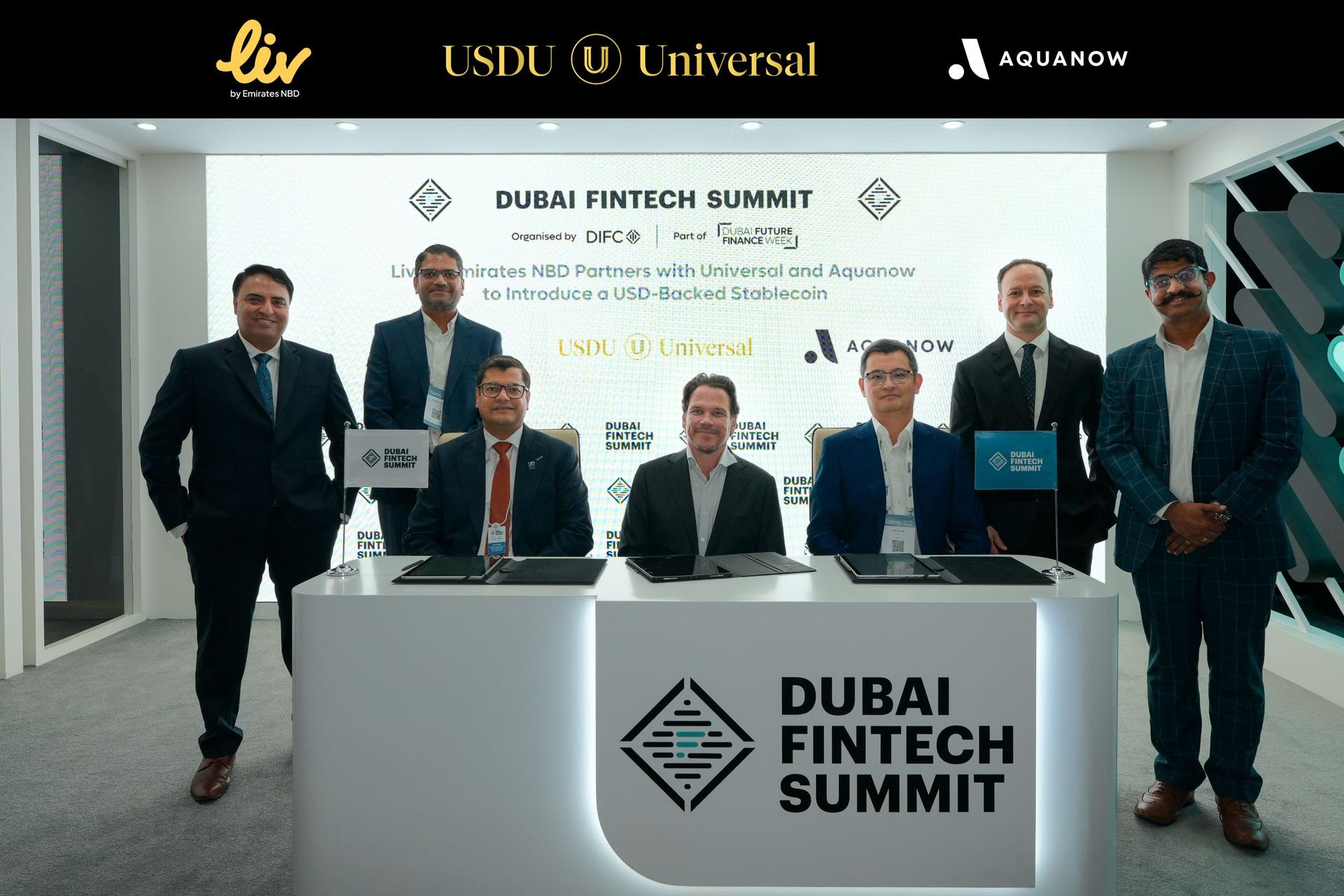
Emirates NBD's Liv digital banking app is integrating the USDU stablecoin via Aquanow, giving Universal's UAE-regulated digital dollar access to nearly half a million Liv customers while Emirates NBD simultaneously safeguards part of USDU's dollar reserves.
Emirates NBD’s Liv is adding the USDU stablecoin to its digital banking ecosystem through a partnership with Universal and Aquanow, giving the UAE-based digital dollar a new route to customers.
Announced on November 9, the integration extends an existing relationship. Emirates NBD already safeguards part of the dollar reserves backing USDU. Through Liv, the banking group is now also providing a platform through which customers can access the token.
For Universal, that connects two important parts of its business: the banking relationships behind its stablecoin and the distribution needed to make it accessible.
The announcement also gives practical context to a question Universal has been examining as UAE banks develop their own blockchain-based services: where does a regulated stablecoin fit alongside conventional accounts and tokenized deposits?
Liv’s integration builds on digital-asset trading introduced through Liv X in 2025. Aquanow provides the infrastructure behind both that service and USDU’s distribution, allowing the partners to build on an existing arrangement.
The potential reach comes from Liv’s established customer base, which the announcement puts at close to half a million users. For USDU, the partnership adds a banking-app channel to its existing platform distribution, including Crypto.com.
Rohit Garg, Group Head of Retail Products and Chief Digital Officer of Retail Banking and Wealth Management at Emirates NBD, described the integration as offering customers “a secure, transparent and regulated bridge to digital assets within their everyday banking app.”
The roles are distinct. Universal issues USDU, Aquanow provides distribution and digital-asset infrastructure, and Liv supplies the customer-facing platform. Emirates NBD and Mashreq hold the reserves backing the token.
USDU is issued under the Fiat-Referenced Token framework of the FSRA in ADGM and registered as a Foreign Payment Token under the Central Bank of the UAE’s Payment Token Services Regulation. Universal says it is backed one-for-one by dollar reserves held with UAE banks, with independent monthly attestations.
“This is what bank-grade stablecoin infrastructure looks like when it reaches the customer,” Juha Viitala, Senior Executive Officer of Universal, said in the announcement.
The Liv partnership comes as local banks are also exploring how their own deposit services can operate on blockchain infrastructure.
First Abu Dhabi Bank announced live dollar transactions with Citi through Swift’s ledger initiative in September. Mashreq announced its own transaction in October. Both involved tokenized deposits and formed part of the ledger’s pilot program.
These are separate initiatives from the Liv integration. They nevertheless show UAE banks participating in several forms of digital money, with different arrangements for issuance, access and settlement.
“We see tokenized deposits as a complement to USDU, not a competitor,” Viitala told Unlock Blockchain in written responses provided separately from the announcement.
A tokenized deposit remains a claim against a bank and can serve transactions within supported banking networks. Universal sees USDU’s role in connecting institutions with exchanges, liquidity providers and other onchain counterparties that accept the token.
That distinction will continue to evolve. Viitala acknowledges that the overlap increases as banks extend deposit tokens to public networks and more counterparties. Institutions will choose according to the reach, liquidity and regulatory arrangements available for a particular transaction.
For USDU, the Liv partnership demonstrates how a bank can add access to an independently issued stablecoin as part of its wider digital-asset services.
The Emirates NBD connection matters to Universal’s positioning because the company is seeking to serve institutions that want digital-asset access anchored in familiar financial relationships.
“Many banks and larger enterprises here are new to digital assets,” Viitala said. “They would rather use a locally regulated dollar stablecoin than send their dollar exposure to another jurisdiction.”
This is the preference Universal is seeking to address. Its issuer, reserve accounts and principal banking relationships are based within the UAE’s regulatory ecosystem, while international use remains subject to the rules of the relevant markets.
As Unlock previously examinedin its analysis of UAE stablecoin reserves, the location of the financial infrastructure behind a digital dollar matters separately from where the token circulates.
Liv adds a customer-access layer to that structure. The relationship with Emirates NBD now includes both safeguarding reserves and introducing USDU through an established banking platform.
Mashreq illustrates another connection: it supports USDU’s reserves while separately participating in tokenized-deposit transactions. Banks can therefore have several roles in the development of digital money, rather than committing to a single model.
Beyond the Liv offering, Viitala described an anonymized recurring treasury workflow involving a UAE-based regulated financial group.
The group funds a licensed distributor from its UAE bank account and receives USDU in an institutional custody wallet. It then transfers the tokens to a liquidity provider or affiliate operating in another time zone.
The recipient can retain USDU as working capital for another transaction or arrange conversion and a bank payout through the distributor.
Where counterparties accept and can reuse the token, this allows value to remain available for another settlement cycle without requiring a conventional bank payout at every step.
These institutional arrangements are separate from the Liv service. Liv’s existing digital-asset offering does not support external-wallet transfers, so the integration should not be read as providing the same transfer capabilities as an institutional custody wallet.
The distinction also applies to operating hours.
“On-chain transfers and secondary-market liquidity run 24/7,” Viitala said. Distributor inventory can allow clients to receive or deliver USDU outside banking hours.
“Primary issuance and redemption with Universal, and the fiat payout, follow UAE banking hours.”
The practical benefit consequently depends on what the recipient needs: a token balance available for another supported transaction, or money paid into a bank account.
Universal says its liquidity arrangements combine exchange markets, distributor inventory, third-party aggregation and relationships between partners. Viitala acknowledges that established stablecoins have more mature liquidity ecosystems, while emphasizing the company’s ability to source liquidity when required.
The Liv partnership strengthens the access side of that proposition. Customers gain another route to USDU, while Universal gains a presence within a banking platform supported by infrastructure already used for digital-asset trading.
Its mainland UAE scope remains payment and settlement connected to virtual assets and their derivatives, rather than general-purpose domestic payments.
The significance of the Emirates NBD relationship is therefore concrete. A bank that helps safeguard the dollars behind USDU is also bringing access to the token closer to customers through Liv.
Alongside the institutional use cases Viitala describes, that gives Universal a clearer foundation for its next phase: turning banking relationships, regulated issuance and distribution into a digital dollar that customers repeatedly choose to use.

Disclaimer of Warranty
The information provided in this article is for general informational purposes only. We make no warranties about the completeness, reliability, and accuracy of this information. Read full disclaimer

Editor's Picks
Binance After the $6.3B Hack: A Turning Point for the Exchange

Walid Abou Zaki

Nov 2, 2026

10 min

“One Financial System”: What OKX’s New Investors Are Backing
Walid Abou Zaki
Oct 8, 2026
6 min

When Assets Move—or Stop—Without Consent: The Limits of Crypto Wallet Control
Walid Abou Zaki
Sep 29, 2026
6 min
Read More Articles

In the Same Space
Soter Insure Adds Standard Chartered's SC Ventures and SBI to Series B
News Desk
Nov 5, 2026
4 min
Animoca Brands Secures ADGM Financial Services Permission to Manage Collective Investment Funds
News Desk
Nov 2, 2026
3 min
Circle Urges SEC to Classify Payment Stablecoins as Cash and Remove 2% Haircut
News Desk
Oct 30, 2026
5 min
Google Cloud Previews Crypto Custody Service for Institutions
News Desk
Oct 29, 2026
4 min