Advertisement
Infrastructure & Scaling
Stratalink’s Proof of Liquidity Oracle records digital asset market-depth assessments on Canton as the company starts discussions with prospective institutional users.
Share
SN
Senior English Editor


Stratalink Labs has launched its Proof of Liquidity (PoLi) Oracle on Canton MainNet, providing cryptographically signed, on-ledger assessments of digital asset order-book depth for institutional use in collateral and trading decisions. The system currently covers Bitcoin, Ether, Solana, and Canton Coin across two venues, with institutional pilots still at an early discussion stage.
Stratalink Labs has launched its Proof of Liquidity (PoLi) Oracle on Canton MainNet, introducing a system designed to help institutions assess the depth of digital asset markets through signed, verifiable liquidity records.
The London-based company is addressing a practical question for lenders, trading desks and collateral managers: how much market liquidity is available behind an asset when a position needs to be reduced or sold?
Founded in 2025 by Robert McDermott, who spent 27 years in institutional markets at Goldman Sachs and Deutsche Bank, Stratalink is now moving into its commercial rollout. McDermott told Unlock Blockchain that discussions about potential pilots on Canton are at an early stage and that institutions are not yet using the system.
“Every decision about collateral, reserves or venue selection rests on trusting that a market is as deep as it looks,” said Robert McDermott, Founder and CEO of Stratalink. “The PoLi™ Oracle replaces that trust with evidence institutions can independently verify on the ledger, on demand. Proof of Reserves tells you an asset is held. Proof of Liquidity tells you whether the market behind it is deep enough to rely on. IntellectEU and CatalyX gave us a dependable route to production, and every attestation we record adds to a verifiable track record for digital asset liquidity.”
One application concerns stablecoins, where reserve backing and secondary-market liquidity measure different aspects of risk.
A token may be fully backed while trading in markets with limited depth. Its reserve position alone does not establish how easily a holder can sell a large amount on an exchange, at what price, or under stressed conditions.
“PoLi assesses secondary-market liquidity, meaning the depth of the order books where the asset trades. It does not assess reserve quality or redemption access, which are separate questions,” McDermott told Unlock Blockchain.
He confirmed that a fully backed stablecoin could receive a poor liquidity score if its markets were thin or fragmented.
For institutions, the distinction creates a role for liquidity analysis alongside reserve assurance and an assessment of redemption arrangements. Each addresses a different part of the decision to hold, accept or trade an asset.
The consequences of disappearing liquidity were visible during the October 10, 2025 market disruption.
In its analysis of the event, FTI Consulting reported more than $19 billion in leveraged liquidations in roughly a day. It also found that Bitcoin’s top-of-book depth fell by more than 90% on key venues during the episode, as market makers widened spreads or withdrew.
McDermott pointed to collateral management as one potential application. A lender could use a verifiable liquidity assessment to inform the discount, or haircut, applied to an asset’s collateral value, as well as the amount it is willing to accept.
A trading desk could similarly use the information when assessing which venue appears capable of absorbing an intended trade.
These are proposed applications of the system. Their practical value will depend on how institutions incorporate the scores into their risk and trading processes.
McDermott previously argued for stronger pre-trade evidence in a commentary published by Unlock Blockchain. The Canton launch gives that argument an operational product around which Stratalink can begin client discussions.
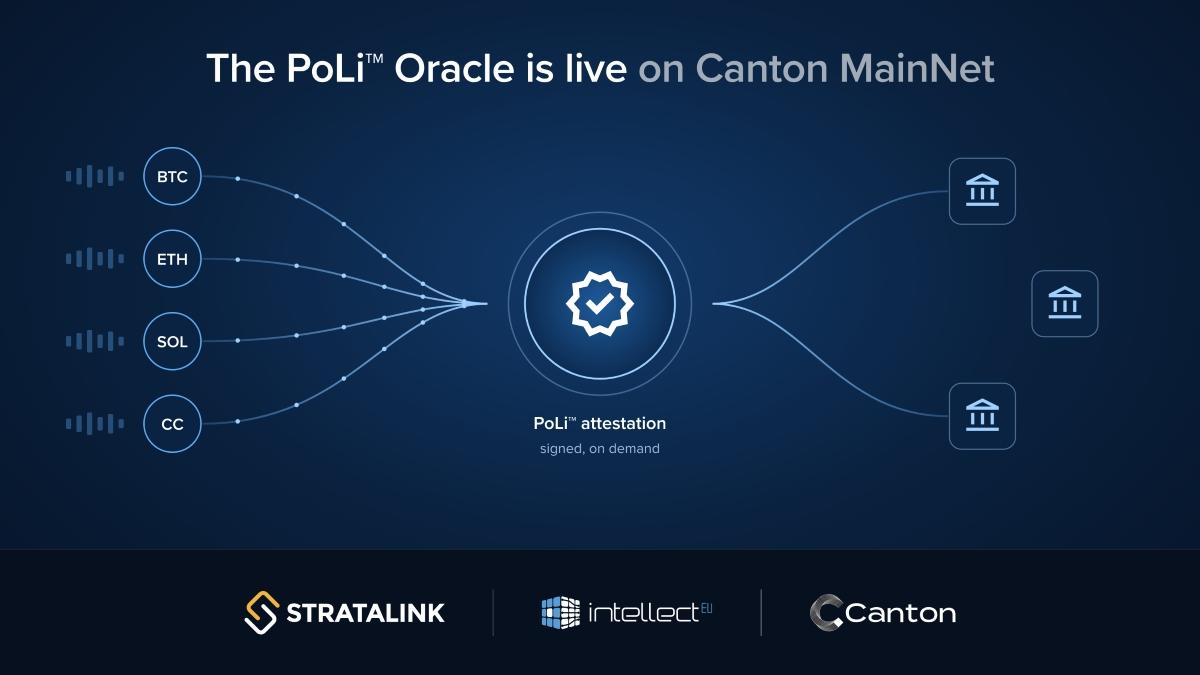
According to Stratalink, PoLi scores order-book data observed directly from trading venues, independently of those venues. Each score is cryptographically signed and recorded as an attestation on Canton, allowing authorized parties to verify the recorded assessment and its timing.
The initial deployment covers Bitcoin, Ether, Solana and Canton Coin across two venues.
McDermott drew a clear boundary around what the record establishes.
“It is evidence about the observed book at a point in time, not a guarantee that any particular order will fill,” he said.
That qualification matters because order books can change between observation and execution. The signed record provides an auditable reference for the assessment; its usefulness also depends on the underlying data, scoring methodology and how recently the observation was made.
IntellectEU built the Daml smart contract layer for the Canton integration. The deployment runs on a validator provisioned through CatalyX Blockchain Manager, with attestations recorded and subjected to an on-ledger compliance check, according to the announcement.
“Our team worked closely with Stratalink Labs to build the Daml smart contract layer for the PoLi™ Oracle’s Canton integration, running on a validator provisioned through CatalyX Blockchain Manager. Every liquidity score is now signed, recorded on-ledger and given a compliance check within seconds. Seeing it run reliably on MainNet is what we set out to deliver, and it gives Stratalink Labs a strong base for the institutions that will rely on it next,” said Anastasiia Vitmer, Head of Product Growth, IntellectEU.
“With this oracle live on Canton, institutions can easily verify market depth for themselves, and this will help support the growing institutional adoption on the network,” said Amanda Martin, Chief Operating Officer, Canton Foundation.
The next phase is intended to allow external consumers to request attestations through their own validators, alongside expanded coverage of venues and assets.
McDermott described PoLi as the main operational layer within Stratalink’s six-layer technical architecture.
Supporting components include its Digital Asset Consolidated Tape, or DACT; Proof of Market Integrity, or PoMI; and STRATA AI. He said these work together to support PoLi’s scoring function and can also serve separate use cases.
Stratalink’s website describes DACT as recording market events with their source and sequence information. PoMI assesses cross-venue coordination, while an early-warning system within STRATA AI is designed to flag combinations of stress signals. The website says rule-based detection is live and machine-learning capabilities are being introduced progressively.
The broader proposition is to connect traceable market data, liquidity assessments and risk signals within infrastructure that institutions can examine and use in their own workflows.
With PoLi live on Canton, Stratalink is beginning the process of turning its infrastructure into a service used by market participants.
McDermott said the company deliberately waited until the oracle was running on the live network before starting substantive conversations with prospective clients and network participants. Discussions about potential pilots are underway, while institutional use remains ahead.
The launch therefore marks a technical milestone. The next evidence will come from institutions testing how the scores inform collateral limits, venue selection and other risk decisions.
For lenders and trading desks, the practical question is whether a traceable liquidity assessment can improve a decision before capital is committed. Stratalink now has a live system with which to test that proposition.

Disclaimer of Warranty
The information provided in this article is for general informational purposes only. We make no warranties about the completeness, reliability, and accuracy of this information. Read full disclaimer

Editor's Picks
In the Same Space

Vitalik Backs Ethereum Gas Changes Ahead of Glamsterdam

News Desk

Nov 16, 2026

4 min

Commercial Bank of Dubai (CBD) Completes Wholesale Digital Dirham Transaction With Bank of China Through UAE's Jisr
Anna K.
Nov 10, 2026
3 min

OpenAssets Establishes Middle East Headquarters in Abu Dhabi, Joins Hub71
News Desk
Nov 10, 2026
3 min

Is ETH the Next Bitcoin? Vitalik Reopens the Store-of-Value Debate
News Desk
Nov 9, 2026
7 min