Advertisement
Companies & Deals
Share
CA
Senior Arabic Editor


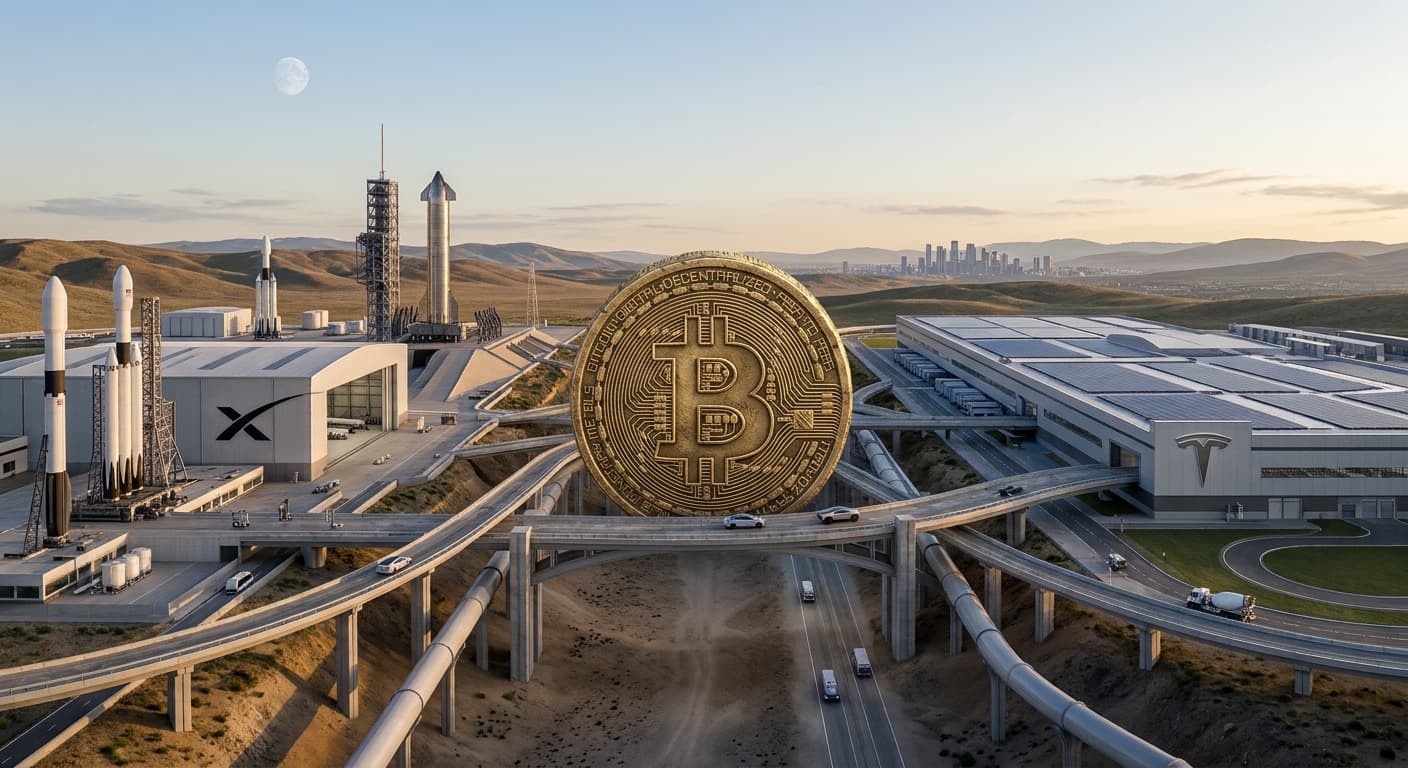
SpaceX and Tesla are exploring a merger that would combine 30,221 BTC, worth roughly $2.5 billion, in one corporate treasury. Elon Musk confirmed the talks during SpaceX’s Q3 earnings call, noting that no terms have been agreed.
Elon Musk has spent years blurring the line between tech, space and crypto. Now two of his biggest companies may be merging, and bitcoin is part of the deal.
During SpaceX’s third-quarter earnings call on Tuesday, Musk confirmed that SpaceX and Tesla are exploring a tie-up. Both companies have formed special committees of independent directors to assess it. If the deal goes ahead, it would combine SpaceX’s reported 18,712 BTC with Tesla’s 11,509 BTC, for a total of 30,221 BTC in one corporate treasury. With bitcoin trading at about $82,800 early Thursday, that stack is worth roughly $2.5 billion.
Musk was careful. He said a merger would be “a good idea,” but that “the shareholders have to be supportive of this.” Because he holds large stakes in both companies, he cannot take part in the committee discussions.
He described it as “an odd kabuki dance” in which two groups talk while he is shut out of the room. He also said the committees have not agreed on the terms of any transaction, and he cautioned against treating a deal as certain, according to Yahoo Finance’s live coverage. For now this is exploration, not an announcement.
His stakes explain why the independent committees matter. Musk owns about 36% of SpaceX outright, rising to 48.4% with restricted shares and unexercised options, according to a June filing. His reported beneficial ownership of Tesla is 19.8%, including restricted compensation shares. He holds only about 20% of Tesla, yet he controls most of SpaceX’s voting power through dual-class shares. That imbalance will make the independence of the committees a central question.
The timing is notable. SpaceX posted revenue of $14.58 billion against a consensus of $12.7 billion, and earnings per share of 35 cents against a 15-cent forecast. Shares jumped about 9% to $161 in Wednesday’s premarket trading.
Capital expenditure reached $19.59 billion, including $16.44 billion for AI. That spending shows how capital-hungry the company has become, and it hints at one logic behind a merger: funding AI infrastructure at this scale takes enormous resources, and a combined balance sheet is a bigger one. The results also helped revive battered AI stocks, which shows how much sentiment around Musk’s companies spills into the wider market.
Tesla reported after Wednesday’s close, and its numbers tell a very different story from SpaceX’s. Revenue came in at $28.05 billion, flat year over year and in line with the roughly $28.06 billion Wall Street expected. Adjusted earnings per share of $0.48 beat the $0.45 consensus but were down from $0.50 a year earlier.
Profitability took the hit. GAAP net income fell 43% to $787 million, and GAAP EPS dropped to $0.22 from $0.39.
Operating income fell 56% to $718 million, as operating expenses rose about 39% on higher R&D and lower regulatory credit income.
Automotive revenue slipped 3% to $20.6 billion and energy generation and storage fell 16% to $2.9 billion, while services and other grew 33% to $4.6 billion.
There were bright spots beyond the headline numbers. Active FSD subscriptions reached 1.74 million, up 67% year over year, and Cybercab robotaxi rides began. Tesla also generated about $1.53 billion in free cash flow and ended the quarter with $45.45 billion in cash and marketable securities.
For the merger story, the takeaway is that Tesla’s core car and energy businesses are under pressure, and the company is spending heavily on AI and robotics to change that. SpaceX is growing fast and also spending heavily on AI. Put them together and you get one balance sheet funding a very large AI build-out. Bitcoin matters in that picture as a liquid reserve asset, not as a growth driver.
The merger’s most interesting effect may be on bitcoin ownership. Today, SpaceX and Tesla are two separate corporate holders. Combined, they would rank sixth among publicly traded corporate bitcoin holders, behind Strategy, Metaplanet, Twenty One Capital, MARA Holdings and Strive.
That concentration changes the narrative. Spread across two companies, the coins are a footnote on two balance sheets. Combined, they become one headline number on a single set of financial statements, controlled by one decision-making structure.
It also turns treasury policy into a single decision, and the two companies have treated bitcoin very differently. Tesla bought $1.5 billion of bitcoin in 2021 and sold about 75% of it the following year to raise liquidity, while SpaceX kept a substantial position that cost about $661 million.
A merged company would have to choose one strategy: hold, add or reduce. Neither company has disclosed any plan to buy or sell bitcoin in connection with the talks.
Finally, a merger would reinforce bitcoin as a corporate reserve asset. If one of the world’s most scrutinized corporate groups keeps bitcoin on its books through a merger, that is a quiet endorsement. Tesla’s own history is a reminder that this is not guaranteed, since it has already sold most of its original stack once.
The price backdrop adds context. Bitcoin briefly pushed above $84,000 late Wednesday before slipping back toward $82,500 as tech futures weakened. It has traded roughly between $80,000 and $85,000 for much of October, still about a third below its record near $126,000.
At today’s price, the combined 30,221 BTC is worth about $2.5 billion. That is around 5% of Tesla’s cash pile alone and roughly an eighth of what SpaceX spent on capital expenditure in a single quarter. The bitcoin is meaningful as a signal, but it is a small part of the balance sheet next to the AI bet.
One more detail matters for analysts. SpaceX’s disclosed holding is more than double the amount identified in existing blockchain tracking data. The disclosed figure and the on-chain picture do not fully match, which is worth watching as more filings arrive.
Musk’s companies have long been among the best-known corporate names in crypto, and this story strengthens that link. It also shows how crypto markets have become a real-time sentiment gauge for traditional companies.
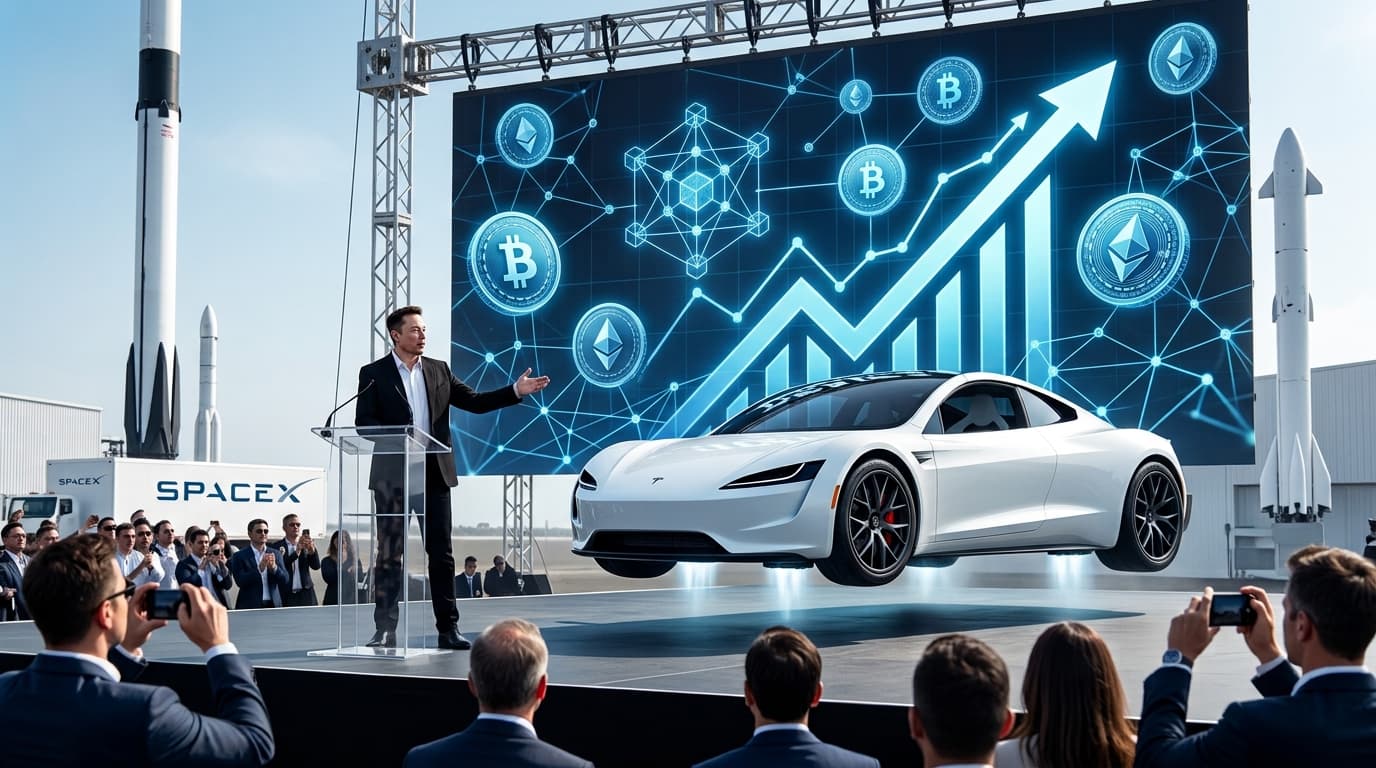
A recent example came when Musk unveiled a flying version of the Tesla Roadster on October 15, powered by thruster technology associated with SpaceX. Tesla shares had closed at $362.44, but U.S. stock markets were closed when the reveal happened. Crypto traders reacted anyway. On Hyperliquid, the TSLA perpetual futures contract climbed about 4.9% to around $378. Hourly volume jumped roughly 1,580%, from $2.8 million to $47 million.
That session became the second-busiest day for the contract since its listing about a year earlier, even though the daily candle was only nine hours old. Binance recorded $279 million in 24-hour volume, against $159 million on Hyperliquid, but Hyperliquid led on open interest with about $99 million in outstanding positions, according to RootData. The contract is listed through Trade.xyz and settles in USDC with up to 20x leverage. It is a perpetual futures contract, not a tokenized share, so it carries no ownership or shareholder rights.
The lesson is that crypto venues now trade stock-market reactions before stock markets open. If a SpaceX-Tesla merger moves closer, expect these platforms to be the first place traders express a view, around the clock.
The outcome for crypto depends on what a merged company does with its bitcoin, and there are three broad paths. In the bullish case, the combined company holds its coins and signals long-term commitment, which strengthens the corporate-treasury thesis and encourages other boards to consider bitcoin. In the neutral case, the merger proceeds and bitcoin policy stays unchanged, so the headline fades while the combined holding remains a visible fixture. In the cautious case, integration leads to a rebalancing of the treasury. Even a partial sale would draw attention, though 30,221 BTC is small next to the overall market.
Which path plays out depends on terms nobody has agreed yet. The committees have not reached agreement, and shareholder support is required.
Nothing here is confirmed, and Musk himself stressed that no terms have been agreed. Regulation could prove the biggest obstacle. JPMorgan sees strategic benefits but flags regulatory approval in China as potentially the largest barrier. Governance is also complicated, since Musk’s stakes of up to 48.4% in SpaceX and 19.8% in Tesla guarantee intense scrutiny of the process, and Tesla’s falling profits and rising AI spending will shape how shareholders value any exchange ratio.
Timing is another unknown. Ark Invest said a SpaceX-Tesla merger could happen within the next five years, so this may be a long process rather than a quick deal. And as the Roadster episode showed, volume spikes are not the same as conviction: trading surges around announcements can fade quickly, and leverage amplifies swings and liquidation risk.
A merger is far from guaranteed. But the fact that bitcoin features so prominently in the discussion tells us something. A decade ago, a company holding 30,000 BTC would have been seen as an outlier. Today, it is part of the arithmetic when two of the world’s most-watched companies consider joining forces.
Whether the deal happens or not, crypto readers should watch this story closely. It shows how bitcoin, AI, space and traditional markets are converging, and how fast crypto venues now react to every move.

Disclaimer of Warranty
The information provided in this article is for general informational purposes only. We make no warranties about the completeness, reliability, and accuracy of this information. Read full disclaimer

Editor's Picks
In the Same Space
Payward Targets EU Banking Expansion With Saldo Deal

News Desk

Oct 15, 2026

3 min
Tesla Crypto Trading Spikes After Elon Musk Showcases SpaceX-Powered Roadster
News Desk
Oct 16, 2026
4 min
Standard Chartered Signs Deal to Acquire Zodia Custody
News Desk
Oct 21, 2026
3 min
JPMorgan Takes JPM Coin to Ethereum in Major Push to Bring Bank Deposits Onchain
News Desk
Oct 19, 2026
5 min