Advertisement
Markets
Share
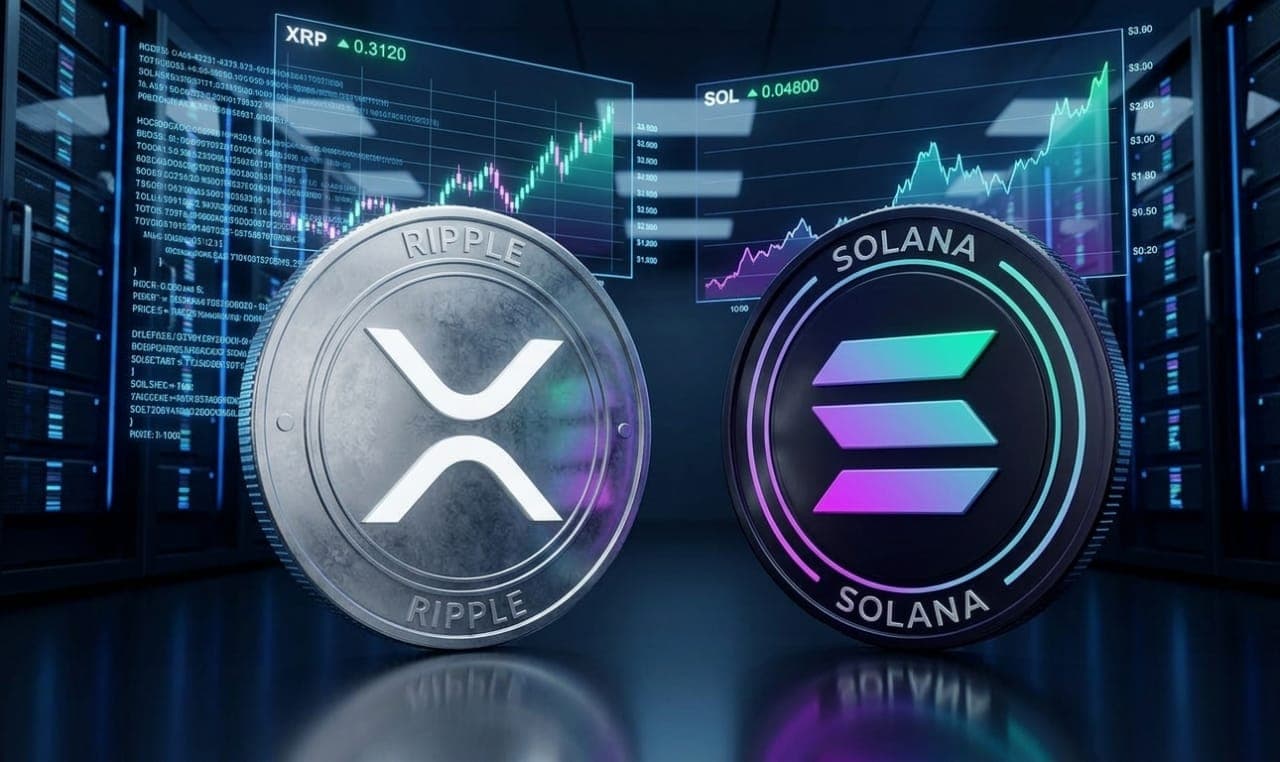
Exchange-traded funds (ETFs) tied to Solana and XRP in the United States are attracting investor capital despite declining cryptocurrency prices, though the two products are developing markedly different investor bases. According to a report from Bloomberg Intelligence analysts James Seyffart and Sharoon Francis,Solana ETFs are drawing stronger participation from institutional crypto investors, while XRP ETFs appear to rely more heavily on retail demand.
The report found that approximately 49% of assets in U.S. spot Solana ETFs were identifiable through Form 13F filings as of December 31. These disclosures are required from large institutional investment managers overseeing more than $100 million in assets.
Investment advisers accounted for the largest share of disclosed holdings, with around $270 million in exposure, followed by hedge funds with approximately $186 million.
The analysts noted that the early investor base remains concentrated among crypto-focused investment firms and market makers, indicating that broader institutional participation is still developing.
Among the largest known holders are Electric Capital, Goldman Sachs, and Elequin Capital.
Solana is a blockchain network designed to support decentralized applications, including trading platforms, lending services, and NFT marketplaces. The network has gained popularity among developers and traders due to its relatively high transaction throughput and lower costs compared with some competing networks.
Some of the initial capital entering Solana ETFs may represent investors shifting existing token holdings into regulated ETF structures rather than entirely new purchases.
However, the Bloomberg Intelligence analysis suggests that reallocation alone does not fully explain the flows. Because roughly half of the ETF assets are visible through 13F disclosures, even assuming those positions represent converted exposure would still leave a significant portion of inflows coming from new investors.
So far in 2026, Solana ETFs have attracted approximately $173 million in net inflows, bringing cumulative inflows since launch to roughly $1.45 billion.
While this figure represents only about 2.5% of the assets gathered by spot Bitcoin ETFs, the analysts described it as relatively strong for recently launched products.
The inflows have occurred despite a sharp decline in Solana’s market price. The token has fallen more than 50% since October, when new spot ETFs launched under the Securities Act of 1933.
At the same time, some common ETF trading strategies appear less attractive. Futures basis yields — often used by hedge funds to conduct arbitrage strategies between spot and derivatives markets — have compressed.
According to the report, the reduced yield environment limits incentives for hedge funds and market makers to establish new arbitrage positions in Solana ETFs.
The ownership structure of XRP ETFs appears significantly different.
Only about 16% of XRP ETF assets were identifiable through 13F filings at the end of December, suggesting a smaller institutional presence compared with Solana funds.
Among the disclosed positions, investment advisers again accounted for the largest share with approximately $165 million, while hedge funds held around $37 million.
The remaining assets are likely held by investors who are not required to submit 13F filings, including retail market participants.
The analysts concluded that a significant portion of XRP ETF ownership likely comes from individual investors rather than large institutions.
XRP ETFs gathered more than $1.4 billion in assets within six weeks of launching in November and have largely maintained those holdings into 2026.
This stability has occurred even as XRP prices have declined roughly 26% this year.
According to the report, the resilience in assets despite weaker derivatives activity suggests that demand for XRP ETFs may increasingly reflect direct market views rather than arbitrage strategies tied to futures markets.
The differing ownership structures highlight how newer cryptocurrency ETFs are still forming their investor bases.
While Bitcoin ETFs have achieved broader institutional adoption since their launch, Solana and XRP funds appear to be developing distinct market dynamics. Solana ETFs are attracting a larger share of crypto-native institutional capital, while XRP funds appear to be drawing stronger participation from retail investors.

Disclaimer of Warranty
The information provided in this article is for general informational purposes only. We make no warranties about the completeness, reliability, and accuracy of this information. Read full disclaimer

Editor's Picks
In the Same Space

Bitcoin ETFs Record $910M in Two-Week Outflow Streak as Inflation Concerns Persist

News Desk

Oct 19, 2026

4 min

Tesla Crypto Trading Spikes After Elon Musk Showcases SpaceX-Powered Roadster
News Desk
Oct 16, 2026
4 min

JIOUSDT: Bitget Brings Jio’s IPO Into Crypto Trading
Walid Abou Zaki
Oct 16, 2026
7 min

Standard Chartered Extends Crypto Trading to UAE Wealth Clients
News Desk
Oct 14, 2026
3 min