Advertisement
Stablecoins & Payments
Share
WA
CEO & Editor-in-Chief


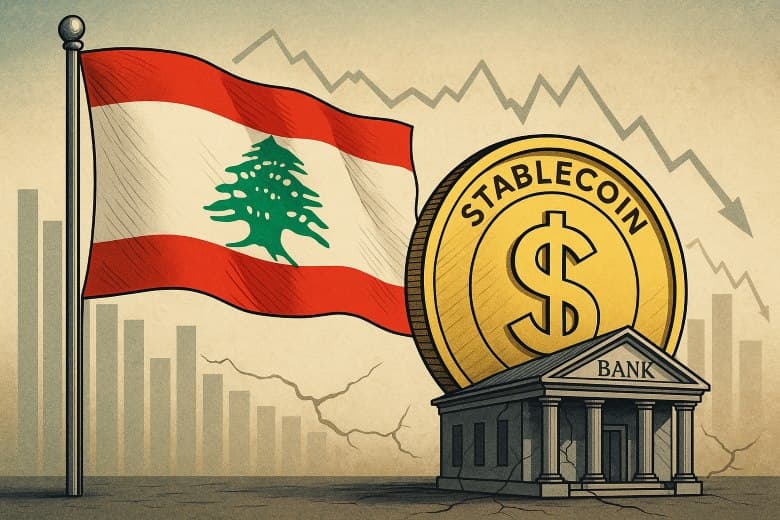
Lebanon’s financial crisis has turned millions into economic hostages. Between frozen deposits, a collapsing currency, and fragmented dollar rates, trust in banks has all but evaporated. As the new Central Bank Governor focuses on stabilizing what remains, there is a temptation to avoid adding new complexities like stablecoins. But in reality, Lebanon stablecoin regulation could offer the country a path to modernize its financial system and restore dignity to its people.
The Lebanese banking sector, once seen as the region’s most stable, has collapsed under its own weight. Depositors remain locked out of their savings. Dollars trapped in banks trade at heavy discounts, creating parallel economies where value depends on who holds it, and where.
Today, the Central Bank’s priorities are understandable. With an IMF-backed bank restructuring law on the table and ongoing negotiations with international partners, digital assets may seem like an unnecessary headache. The new governor, who has lived the pain of this crisis, is unlikely to welcome additional risks onto his already heavy agenda.
Stablecoins do not replicate traditional banking services like loans or deposits. Their true value lies elsewhere: empowering people with digital dollars they can own and move freely. In a country where the banking promise has been broken, this alone is transformative.
Globally, regulators are beginning to recognize this role. In the US, the newly reintroduced Genius Act seeks to integrate stablecoin issuers into federal banking frameworks, reflecting an understanding of their systemic importance for payments and settlements. Meanwhile, in the UAE, the Central Bank’s payment token regulation has created a clear legal path for dirham- and dollar-backed stablecoins to operate under strict compliance, positioning stablecoins as part of mainstream finance rather than the periphery.
While advanced economies debate frameworks, Lebanon is already living the utility of stablecoins. Unlock Blockchain previously reported that over $30 million in stablecoin transactions occur monthly in Lebanon, driven by peer-to-peer networks and OTC desks. In a country where banks have blocked access to deposits for years, stablecoins function as practical, real-dollar alternatives – not in theory, but on the ground, today.
One expert recently noted, “Stablecoins are not a threat to monetary policy or a money laundering risk. In fact, it’s the opposite. We have no idea how much USD fiat is circulating in Lebanon, nor does the Central Bank.” In a cash-heavy economy, Lebanon stablecoin regulation could bring visibility, accountability, and compliance benefits – a crucial advantage as the country seeks to exit the FATF grey list.
For Lebanese small holders who lost faith in banks, stablecoins combined with self-custody wallets offer direct control over their funds without institutional dependence. This aligns naturally with Lebanon’s cash culture, where people prefer to hold their own money rather than entrust it to banks.
Integrating staking with stablecoins can take this further. It allows holders to earn passive income on their digital dollars, offsetting inflation and creating new micro-investment opportunities. In a country with minimal financial products accessible to ordinary people, staking transforms stablecoins from merely protective tools into engines of economic resilience.
While cross-border payments remain the most immediate and valid stablecoin use case – Lebanon receives $6-7 billion annually from its diaspora – the broader potential is in building a financial system that works for people, not just institutions. A system rooted in transparency, portability, and self-sovereignty.
It is easy to imagine why Lebanon’s Central Bank might avoid opening the stablecoin conversation today. The fear of regulatory complexity, illicit finance risks, and public expectations are real. But what is the alternative? Rebuilding the same banking model that broke so catastrophically? Or embracing Lebanon stablecoin regulation to integrate solutions that match the country’s true character: global, mobile, and resilient.
Digital assets go beyond stablecoins. Bitcoin has proven itself as a store of value globally, yet most Lebanese never had proper access or exposure to it. Instead, they were offered inflated bank interest rates or investment plans that turned out to be scams, leaving them with nothing as institutions collapsed overnight.
Lebanon is not an island. It cannot continue disconnecting from the world while global capital markets become accessible to everyone through tokenized stocks and digital assets. Meanwhile, Lebanon remains stuck in the past, protecting the same players who contributed to the collapse. If there is no accountability for those who acted irresponsibly, this might pass, but continuing to grant them the same rights and advantages is not just negligence – it is a new crime against the people.
Lebanon does not need another fragile banking fix. It needs a financial reset grounded in transparency, interoperability, and trust. Stablecoins, self-custody, staking, and a broader embrace of digital assets may seem like unwelcome disruptions today – but they might just be the only path to a financial future that truly works for Lebanon’s people.

Disclaimer of Warranty
The information provided in this article is for general informational purposes only. We make no warranties about the completeness, reliability, and accuracy of this information. Read full disclaimer

Editor's Picks
In the Same Space
SoFi Bridges Bank Deposits and Onchain Finance With New Tokenized Dollar

News Desk

Oct 23, 2026

4 min
Qivalis Secures Dutch Approval for Euro Stablecoin
News Desk
Oct 15, 2026
3 min

SpaceX and Tesla Eye a Merger: Could 30,221 BTC Reshape Corporate Bitcoin Holdings?
Chantal Assi
Oct 22, 2026
9 min
Standard Chartered Signs Deal to Acquire Zodia Custody
News Desk
Oct 21, 2026
3 min