Advertisement
Research & Analysis
For first-time crypto exchange users, the next rally may offer something less ambitious than a profit: a chance to get out.
Share

WA
CEO & Editor-in-Chief


Major crypto exchanges report hundreds of millions of registered users, but declining trading volumes, steep drawdowns, and security incidents are testing whether recent entrants will remain active investors. The article examines the gap between user milestones and actual engagement, drawing on exchange disclosures, Glassnode data, and Urban Institute survey findings.
Someone who entered the market during the past nine months may have experienced uneven returns, a recovery that failed to hold, security incidents and another sharp decline. For that investor, the question can shift from how much a portfolio might earn to how much of the original investment can be recovered.
That possibility sits behind the enormous user milestones announced by the world’s largest exchanges. Platforms have attracted audiences measured in tens or hundreds of millions. The harder test is turning those registrations into lasting participation, particularly when a customer’s first market cycle damages both their capital and their confidence.
Five major platforms illustrate how widely exchanges have extended their reach: Binance, OKX, Crypto.com, Bitget and Bybit.
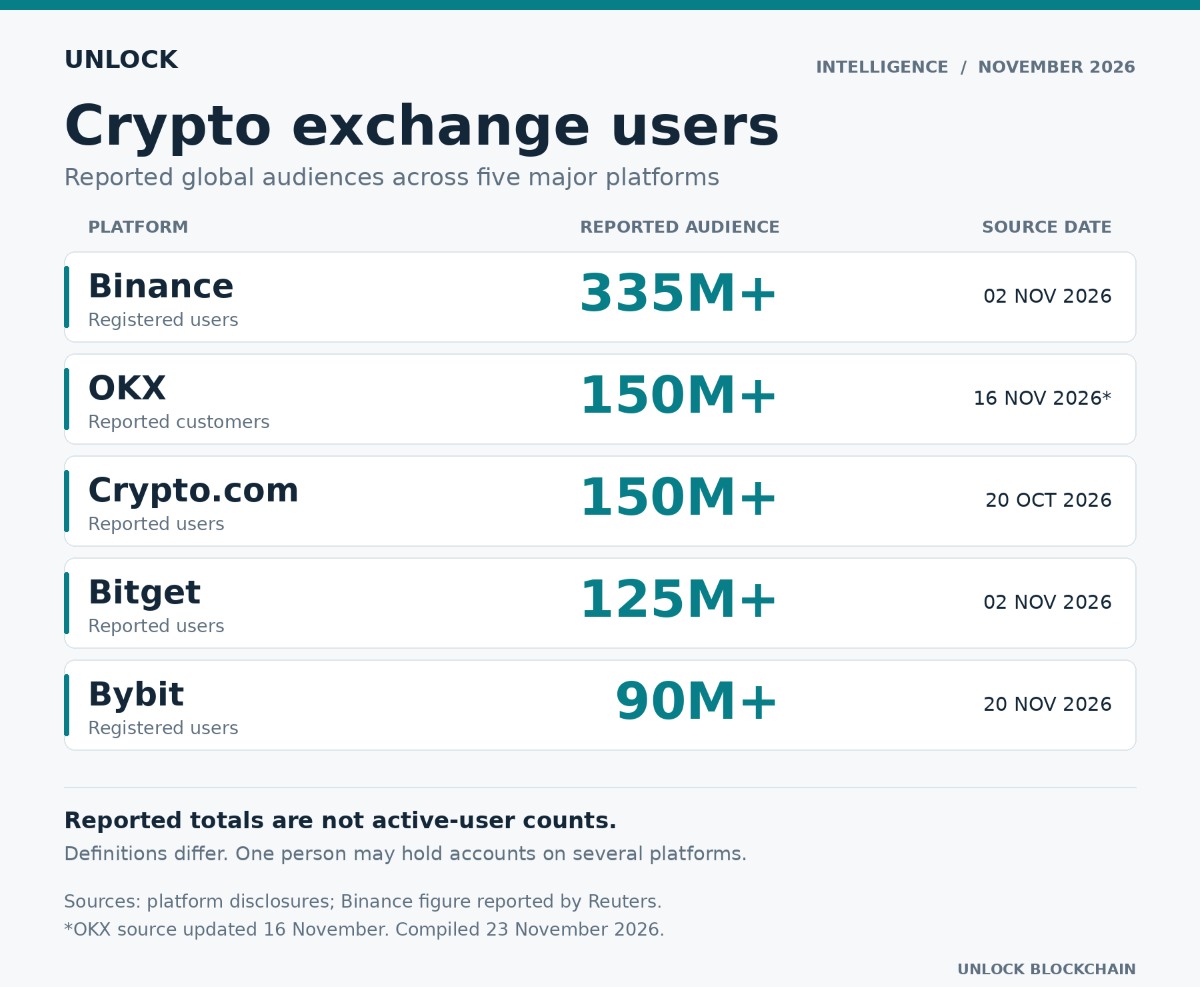
Binance reports more than 335 million users, while OKX and Crypto.com each cite more than 150 million customers or users. Bitget reports more than 125 million, and Bybit more than 90 million registered users. These figures come from company disclosures and reporting published or updated between October 20 and November 20, 2026.
These company-reported figures use different definitions and do not measure comparable active audiences. They also overlap: one investor may hold accounts on several platforms.
A registration can remain in a headline total long after its owner stops depositing or trading. Consequently, rising user milestones can coexist with declining engagement. They establish how many customers platforms have attracted over time, while revealing much less about how those customers are responding to the present market.
At the November 23 research snapshot, Bitcoin traded around $61,000, approximately 52% below its record high. Ether was near $1,725, roughly 65% below its peak, according to CoinGecko.
Those drawdowns do not describe every newcomer’s return. Someone who bought near a market low, traded successfully or took profits during a rally may have had a different experience. The period included meaningful opportunities: Glassnode’s November 17 analysis identified profit-taking by holders of coins under six months old during September and October, followed by renewed loss-taking.
The concern is the durability of that recovery. By November 11, only about 35% of Bitcoin supply held by short-term holders remained in profit, compared with nearly all at September’s high, Glassnode reported.
That measure tracks recently moved coins, broadly those held for less than 155 days. It cannot isolate first-time investors or represent everyone who entered during the past nine months. It nevertheless shows how quickly the position of recent buyers deteriorated.
Security incidents add another reason for customers to question their exposure. Bitget acknowledged a September 24 incident in its Q3 update, while Binance’s October 30 announcement disclosed unauthorized withdrawals and a temporary withdrawal suspension. Both companies said users would be protected from the financial impact. Such commitments address losses at the platform level; their effect on a beginner’s confidence is harder to measure.
There is evidence that losses, volatility and security concerns can end participation.
In a nationally representative US survey conducted in January 2026, former crypto owners cited losing money (32%), excessive price volatility (28%) and security concerns (28%) among their main reasons for stopping, according to the Urban Institute.
The survey predates the latest incidents and selloff. It provides evidence of why people have left, rather than a count of those leaving now.
The inflow of newcomers was also weakening before the latest shock. Philadelphia Fed research published in October found that the share of surveyed crypto owners who had made their first purchase within the preceding year fell from 45% in April 2024 to 35% in April 2025 and 24% in April 2026.
Together, these findings identify two pressures: attracting fresh participants and giving existing customers reasons to remain. They do not establish a global exodus or show that today’s disappointed beginners will never return.
Public company disclosures illustrate why user growth needs to be read alongside activity.
Coinbase reported average monthly transacting users of 7.4 million in Q3 2026, down from 9.3 million a year earlier, a decline of approximately 20%. The company attributed the reduction primarily to fewer trading users amid market conditions.
Robinhood’s October figures show a different divergence. Funded customers across its platform reached 28.9 million, up 7% year on year, while combined Robinhood and Bitstamp crypto trading volume fell 48%. Its funded-customer figure covers multiple asset classes, rather than crypto alone.
Kraken parent Payward reported 7.1 million funded accounts across its group in Q3, up 37% year on year, while total platform transaction volume fell 30%.
These measures are not interchangeable. Funded accounts do not necessarily represent active traders, and dollar trading volumes are affected by asset prices as well as trading behavior. Nevertheless, the disclosures show that larger account bases can accompany weaker transaction activity.
The weakness also extends across trading markets. Coinbase Research reported that October spot, perpetual futures and dated futures volumes fell 16%, 12% and 7%, respectively, from September. Its assessment also identified demand for downside protection in options markets, suggesting caution accompanied the slowdown.
The expansion of exchanges into traditional markets gives this retention question a further dimension.
Bybit’s 90 million-user announcement also reported more than $180 billion in cumulative TradFi perpetuals trading volume by October and over four million cards issued. OKX has expanded stablecoin-backed payments, while Bitget’s Q3 update described a unified account connecting crypto with traditional financial products.
Those strategies give customers more reasons to use a platform when their appetite for crypto weakens. Their contribution to retaining recent entrants remains undisclosed.
An investor who stops buying Bitcoin but stays to trade equities or commodities would represent a different outcome for the exchange and for crypto investment demand. A platform could retain the relationship even as the customer changes what they want from it.
This competition has a direct UAE connection. Bybit identifies Dubai as its international headquarters, while Binance operates its global platform through an ADGM-regulated structure. OKX and Crypto.com hold Dubai licenses. Kraken has secured VARA approval, and Robinhood has obtained DFSA authorization ahead of a planned regional rollout in 2027.
A recovery in prices would ease losses, but it would not by itself establish that recent investors had regained their appetite for crypto.
Some may add to positions. Others may remain inactive, move into different assets or use a rebound to recover their original capital and leave. Glassnode’s November 11 analysis identified recent holders who could use a rally to sell at breakeven, illustrating why improving prices can also create an exit opportunity.
The public data cannot yet determine how many first-time investors fall into each group. Exchange registration milestones offer little help with that distinction.
The next test of adoption is whether crypto exchange users keep funding accounts, investing and using services after their first difficult market experience. For exchanges broadening into financial platforms, retaining those customers may also mean helping them invest somewhere beyond crypto.

Disclaimer of Warranty
The information provided in this article is for general informational purposes only. We make no warranties about the completeness, reliability, and accuracy of this information. Read full disclaimer

Editor's Picks
In the Same Space

CFIX: How CFI’s Trading Scale Could Shape Digital Assets

Walid Abou Zaki

Nov 12, 2026

6 min

ADFW 2026 Unveils Expanded Partner-Led Programme Featuring L’IMAD
News Desk
Nov 20, 2026
4 min

Licensed, Then What? Dubai’s VASP Commercial Reality
Walid Abou Zaki
Nov 18, 2026
6 min

Stake RWA Secures Full VARA License for Broker-Dealer Services in Dubai
News Desk
Nov 11, 2026
3 min