
Advertisement
Markets
Share
Bitcoin briefly dipped below $60,000 before recovering to approximately $61,600, pressured by tighter monetary expectations, ETF outflows, and capital rotation into equities rather than any crypto-specific catalyst.
Bitcoin briefly fell below the $60,000 level in early trading before partially recovering, with prices rebounding to around $61,600 at the time of writing, as global risk assets continued to face pressure from tighter monetary expectations, ETF outflows, and shifting capital flows toward equities.
The intraday move highlights ongoing volatility in a market increasingly shaped by macroeconomic conditions rather than crypto-native catalysts.
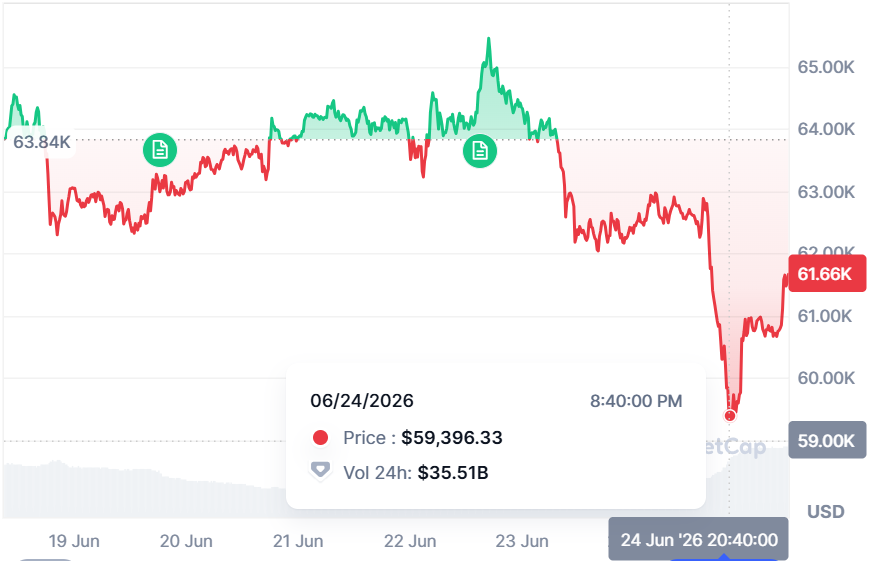
Bitcoin dropped as much as 5.3% to about $59,300, its lowest level since October 2024, breaching a key psychological and technical support level that traders had defended for much of the past two years.
The decline also marks the third time this year that Bitcoin has traded below $60,000, underscoring increasing fragility in the current market structure despite earlier periods of stability.
The primary driver of the decline appears to be a broader sell-off in global risk assets, particularly technology stocks, as markets adjust to expectations of tighter monetary policy.
Equities, including the S&P 500 and Nasdaq Composite, extended losses amid concerns that central banks may maintain or increase interest rates to address persistent inflation pressures. Rising yields and a stronger U.S. dollar have further reduced appetite for risk assets across markets.
Bitcoin’s correlation with equities has reasserted itself in recent weeks, reinforcing its sensitivity to macro liquidity conditions despite periods of partial decoupling earlier in the year.
Market participants have increasingly rotated capital away from digital assets and into AI-linked equities, semiconductor stocks, and high-profile IPOs, including large-scale listings such as SpaceX, with additional anticipated offerings from major AI firms.
This rotation has redirected speculative liquidity toward sectors perceived to offer stronger near-term momentum, reducing demand for cryptocurrencies that previously benefited from risk-on positioning.
Analysts note that sentiment has shifted as AI-driven narratives dominate equity markets, drawing attention and capital away from crypto assets.
Institutional demand has also softened, with Bitcoin exchange-traded funds recording seven consecutive weeks of net outflows, totaling approximately $182 million in outflows this week alone.
Total assets under management in Bitcoin ETFs have declined significantly from roughly $113 billion at the end of last year to about $77.5 billion, indicating a notable contraction in one of the market’s key structural demand channels.
This shift suggests that ETF inflows, which previously provided a strong price support mechanism, are no longer offsetting broader selling pressure.
Sentiment has also been weighed down by continued regulatory uncertainty in the United States, where the CLARITY Act—intended to provide a clearer framework for digital asset markets—remains stalled in Congress.
The lack of legislative progress has reduced expectations for near-term structural catalysts that could support renewed institutional inflows into the crypto sector.
Bitcoin is now approximately eight months into what analysts describe as a prolonged bear market, although the magnitude of the drawdown remains more moderate compared to previous cycles.
Despite sustained downward pressure, volatility has been comparatively contained, reflecting a broader shift in market structure as institutional participation increases and retail-driven extremes become less dominant.
While sentiment remains weak, current conditions suggest that Bitcoin’s decline is being driven primarily by macroeconomic tightening and capital reallocation rather than a breakdown in its underlying market structure.
The combination of rising yields, a stronger dollar, ETF outflows, and rotation into AI-driven equity narratives has created a synchronized pressure environment across risk assets.
For now, Bitcoin’s move below $60,000 appears less like a structural breakdown and more like a repricing of global liquidity conditions—one that continues to shape both traditional and digital asset markets simultaneously.

Disclaimer of Warranty
The information provided in this article is for general informational purposes only. We make no warranties about the completeness, reliability, and accuracy of this information. Read full disclaimer

Editor's Picks
In the Same Space

Deutsche Bank Moves Into Institutional Crypto Custody With Bitcoin, Ether and Stablecoins

News Desk

Sep 17, 2026

4 min

Ethiopia Slashes Bitcoin Mining Power by 77%, Why?
News Desk
Sep 16, 2026
6 min

Bitcoin Takes Hit as Iran Rising Tensions Send Oil Above $100
News Desk
Sep 14, 2026
6 min

Abu Dhabi and South Korea Forge New Financial Links Around Digital Assets and Stablecoins
Chantal Assi
Sep 22, 2026
6 min