Advertisement
Tokenization & RWA
Share
Tokenization has emerged as a prevailing topic of interest, with various entities striving to engage in its realm. The Bank for International Settlements (BIS), alongside seven central banks, has recently unveiled plans to collaborate with private sector entities to explore the potential of tokenization in augmenting the functionality of the monetary system.
Dubbed as Project Agorá, meaning "marketplace" in Greek, this initiative unites the Bank of France (representing the Eurosystem), Bank of Japan, Bank of Korea, Bank of Mexico, Swiss National Bank, Bank of England, and the Federal Reserve Bank of New York. Together, they aim to collaborate with a diverse array of private financial firms coordinated by the Institute of International Finance (IIF).
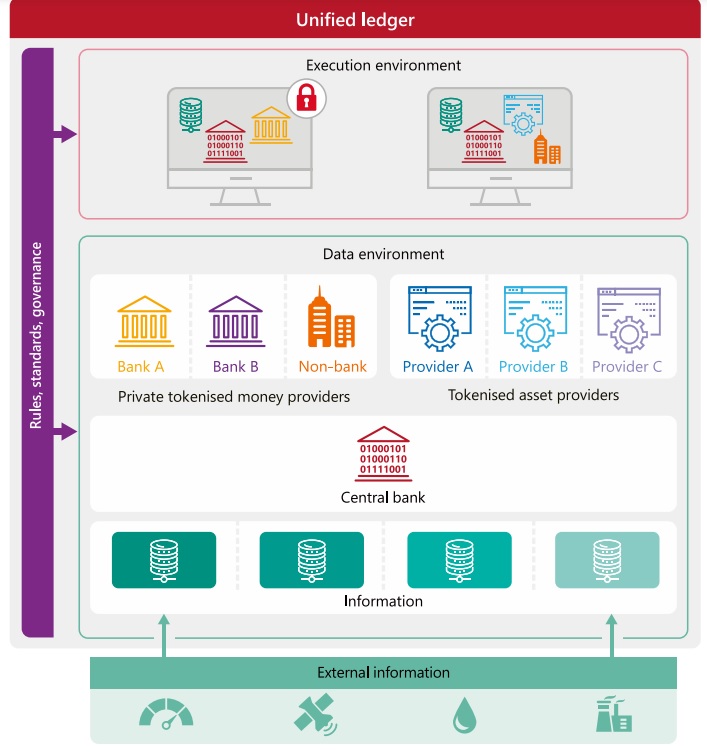
Building upon the unified ledger concept introduced by the BIS, the project will delve into the seamless integration of tokenized commercial bank deposits and wholesale central bank money within a public-private programmable core financial platform. This exploration seeks to enhance monetary system operations and introduce innovative solutions leveraging smart contracts and programmability, while upholding the existing two-tier structure. Smart contracts hold the potential to revolutionize settlement methods and facilitate transactions currently deemed impractical or unfeasible, thereby offering novel opportunities for businesses and individuals.
This extensive public-private partnership endeavors to address several structural inefficiencies prevalent in current payment mechanisms, particularly those spanning across borders. Challenges such as diverse legal frameworks, regulatory prerequisites, operational schedules, and time disparities contribute to complexities in transaction execution. Additionally, the heightened intricacies associated with financial integrity controls, such as anti-money laundering measures and customer verification procedures, often necessitate redundant verifications throughout the transaction chain, depending on the involvement of intermediaries.
Projects under the BIS Innovation Hub are inherently experimental, geared towards exploring and delivering public goods to the global central banking community.
In the subsequent phases, the BIS will solicit expressions of interest from private financial institutions to partake in Project Agorá, with the IIF serving as the intermediary and facilitator for private sector involvement. It is anticipated that multiple regulated financial institutions will engage, representing each of the seven currencies. Detailed guidelines and prerequisites for participation will be communicated in due course, with membership in the IIF not being obligatory for participation.

Disclaimer of Warranty
The information provided in this article is for general informational purposes only. We make no warranties about the completeness, reliability, and accuracy of this information. Read full disclaimer

Editor's Picks
In the Same Space

South Korea Plans Forex Law Change to Cover Stablecoins

News Desk

Oct 23, 2026

3 min
a16z Drops Crypto Label as Fund Expands Into Frontier Tech
News Desk
Oct 23, 2026
5 min
SoFi Bridges Bank Deposits and Onchain Finance With New Tokenized Dollar
News Desk
Oct 23, 2026
4 min
HSBC Brings HKD Stablecoin RedCoin to Retail Payments Through PayMe
News Desk
Oct 23, 2026
3 min