Behind OFAC’s Digital Wall: Can Cuba and its Sisters Survive Through the “Cloud” of Cryptocurrencies?

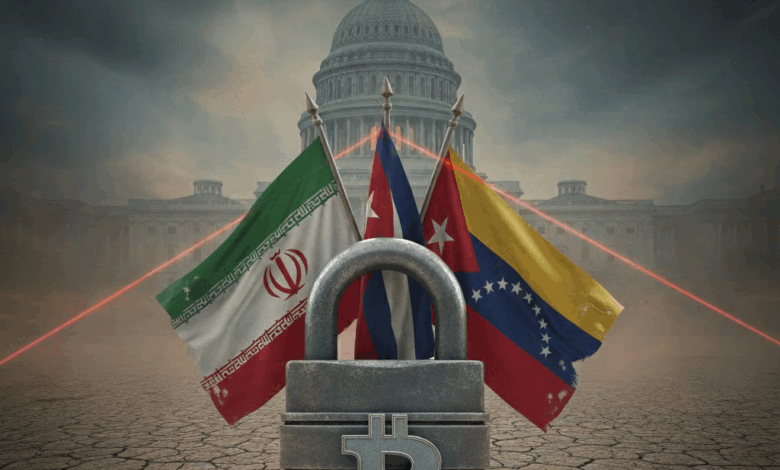
In a world where military power is no longer measured solely by conventional equipment, digital assets have emerged as a hidden battlefield and a strategic tool reshaping the map of international influence. Blockchain technology has evolved from a revolutionary financial innovation into a geopolitical weapon, increasingly leveraged by sanctioned regimes to break the financial isolation imposed by Western powers. This digital transformation is no longer confined to facilitating trade; rather, it has become the backbone of a parallel financial system that challenges the dominance of the US dollar and renders traditional financial censorship increasingly ineffective.
Iran and Circumventing Sanctions: Crypto as a Tool of International Influence
Tehran is no longer content with using cryptocurrency mining merely to address liquidity shortages. By early 2026, it had moved into the most audacious phase of its geopolitical “digital offensive” to date. According to recent investigative reports—most notably by the Financial Times—the Iranian Ministry of Defense’s export arm has unveiled a comprehensive commercial infrastructure enabling foreign governments and entities to purchase strategic military assets, including ballistic missiles, drones, and even warships, with payments settled entirely through digital assets.
This development represents more than a simple circumvention of sanctions; it marks the formal emergence of a sophisticated “digital barter” system that undermines the monopoly of the global SWIFT network. In effect, Iran has constructed a military “electronic gateway” functioning as a free-trade platform for weapons, where negotiations occur through encrypted channels, technical inspections take place within Iranian territory, and funds flow into digital wallets beyond the reach of central banks.
The danger of this model lies in the financial immunity it grants Tehran. International buyers no longer face the risk of asset freezes or traditional OFAC investigations, provided transactions remain within decentralized crypto networks. As a result, cryptocurrency shifts from a volatile investment vehicle into a form of “sovereign fuel” powering Iran’s influence engine, financing military research and expanding regional reach beyond Western surveillance. This reality presents the international community with an unprecedented security dilemma: how do you impose a blockade on a country that sells missiles through a digital cloud leaving no paper trail?
From Havana to Caracas: Digital Exchange and the Risks of a “Post-Colombian Bloc”
Under sustained US economic sanctions, cryptocurrencies have become a concealed lifeline for both Cuba and Venezuela. However, this phenomenon extends far beyond technological adaptation; it reflects an existential struggle in which digital tools are weaponized to bypass a suffocating financial blockade.
In Cuba, cryptocurrencies long operated in a regulatory gray zone. Yet the tightening of US sanctions, particularly during Donald Trump’s presidency, and the resulting deterioration in relations between Havana and Washington effectively severed traditional financial channels. Confronted with this reality, Cuban authorities turned to digital solutions as an alternative economic mechanism. Decree No. 215 of 2021 subsequently legalized and regulated cryptocurrency use under the supervision of the Central Bank.
Nevertheless, this adoption raises critical concerns. Digital assets in Cuba, Iran, and Russia often lack proper registration and institutional custody. Consequently, what occurred in Venezuela—widespread loss and theft of assets, could easily be replicated elsewhere. In the absence of robust oversight, these assets are easily misappropriated, transforming a tool of resilience into a profound security vulnerability.
In Venezuela, the situation goes even further. Cryptocurrency has evolved from an economic survival mechanism into a core pillar of regime survival. In a dramatic turn, the arrest of President Nicolás Maduro and his wife reignited scrutiny of crypto’s role in bypassing traditional banking systems, particularly amid reports that Caracas controls nearly 600,000 bitcoins. Such digital reserves grant the regime unprecedented financial maneuverability beyond the reach of international legal enforcement.
Yet this “digital shield” has begun to fracture from within. A major corruption scandal that erupted in early 2024, culminating in the removal of former Oil Minister Tareck El Aissami, revealed the misappropriation of billions of dollars in oil revenues settled via cryptocurrency channels. The episode confirms longstanding warnings: without institutional safeguards, digital assets become easy prey. Rather than serving as sovereign insurance, crypto has facilitated elite embezzlement, proving that “digital sovereignty” without governance is little more than an illusion.
The Formation of a “Digital Cluster” Isolated from the World
Even more alarming is the fact that reliance on digital assets by Iran, Cuba, Russia, and Venezuela is not occurring in isolation. Gradually, it is giving rise to a “digital cluster” of sanctioned economies operating outside the global financial system. Over time, international trading platforms will face mounting regulatory pressure, increasing the likelihood that assets originating from these jurisdictions will be restricted or banned altogether.
At that point, a more complex phase emerges: the development of informal secondary markets or alternative digital barter systems. In such an environment, cryptocurrencies cease to function as stores of value or transfer mechanisms and instead become closed exchange tools within a parallel economy. This ecosystem could facilitate high-risk activities ranging from arms trafficking and hazardous chemical trade to narcotics, and potentially even more dangerous exchanges.
Washington Tightens the Noose
Washington is closely monitoring the rapid expansion of cryptocurrency usage among sanctioned states, fully aware that their success could neutralize the “weapon of sanctions.” Consequently, US policy has shifted toward a strategy of technological containment.
This approach, however, risks accelerating the formation of a confrontational digital bloc opposing the rest of the world. Looking ahead, digital assets originating from these markets may be entirely excluded from global exchanges. Such isolation would almost certainly give rise to secondary currency systems—or worse, crude and dangerous barter mechanisms. The true threat lies in what these shadow markets enable: the acquisition of illicit goods beyond international oversight, including advanced weapons, hazardous chemicals, nuclear materials, and drugs, turning the crypto space into a theater of catastrophic exchanges that endanger global security.
Between the Hammer of Technology and the Anvil of Sovereignty
By 2026, Washington’s confrontation with the “digital insurgency axis” stretching from Tehran to Caracas and Havana will no longer be merely political. It will resemble an arms race between algorithms and censorship. While sanctioned regimes attempt to shield themselves behind digital “military gates,” ordinary citizens remain the most exposed and least protected.
The defining questions of this decade are stark: Will unregulated digital assets trigger internal chaos and systemic theft? Will the world witness the emergence of a digital black market trading Bitcoin for chemical or nuclear toxins? Or will traditional power dynamics ultimately prevail, proving that—despite technological upheaval, the barrel of a gun still has the final say?