
In late 2025 and the opening days of 2026, two brief social media posts cut through the usual digital noise, not as motivational platitudes, but as carefully timed signals from two of the most influential figures in technology and crypto: Changpeng Zhao (CZ) and Elon Musk.
On December 25, 2025, CZ posted a familiar refrain: “Keep building. 2026 will be awesome!”

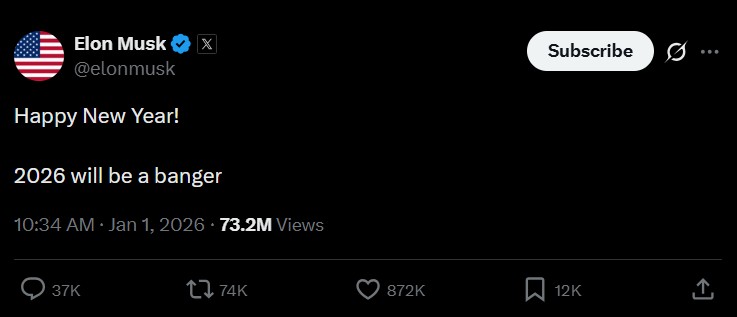
Days later, on January 1, 2026, Musk followed with his own succinct forecast: “2026 will be a banger.”
At face value, both statements appear deceptively simple. Yet their timing, authorship, and broader market context invite a deeper reading of what 2026 may hold for digital assets and why optimism is resurfacing after years of turbulence.
CZ and the Language of Builders, Not Speculators
Changpeng Zhao’s public messaging has long stood apart from the speculative frenzy that often dominates crypto discourse. Rarely does he chase price action or hype short-term rallies. Instead, his recurring emphasis on “building” reflects a strategic worldview centered on infrastructure, resilience, and long-term value creation.
When CZ describes 2026 as “awesome,” the message is less emotional optimism and more structural assessment. The past few years have subjected the industry to one of its harshest stress tests: global regulatory crackdowns, the collapse of entities once deemed “too big to fail,” and a brutal market cleansing that eliminated unsustainable players. What remains, in CZ’s framing, is an ecosystem that has endured its purification phase.
This is not a promise of immediate price appreciation. It is an acknowledgment that crypto has graduated from experimental backrooms into institutional corridors. Bitcoin, once a fringe technological curiosity, now sits on the balance sheets of ETFs and institutional allocators, benefiting from liquidity structures that lend the market an unprecedented degree of stability. In parallel, the industry’s posture toward regulators has shifted from confrontation to compliance, transforming regulation from an existential threat into a protective moat that attracts cautious capital.
Binance’s recent launch of “Binance Junior” further underscores this long-term orientation. By allowing guardians to manage restricted digital accounts for minors, the platform is not merely introducing a new product, it is shaping financial behavior from the ground up. Strategically, this is less about immediate revenue and more about cultivating generational trust, embedding crypto into everyday financial literacy rather than speculative excess.
Elon Musk and Optimism at the Intersection of Narrative and Technology
Elon Musk’s messaging, by contrast, operates in a different register. His statement that “2026 will be a banger” makes no explicit reference to crypto. Yet coming from a figure whose influence has historically rippled through digital asset markets, the remark does not exist in a vacuum.
Unlike CZ’s methodical builder mindset, Musk speaks as an architect of future narratives. His optimism is not anchored in regulatory milestones or balance sheets, but in the anticipation of technological convergence. The subtext of his comment points toward a collision between artificial intelligence and blockchain, where decentralized systems evolve into an invisible yet essential layer managing digital identity, data ownership, and economic coordination.
In this vision, crypto’s next chapter is not about speculation, but integration. Digital assets quietly power payments, data verification, and automated systems, from Tesla’s financial ecosystems to space and communications infrastructure. For Musk, the “banger” of 2026 lies in the moment when science fiction becomes operational finance.
Where the Two Messages Converge
The real significance of these statements lies not in their differences, but in their convergence. Gone are the slogans of past cycles, “to the moon,” parabolic price targets, or empty promises of overnight wealth. In their place emerges a quieter confidence.
Together, CZ and Musk signal a market that has moved beyond survival anxiety. The dominant question is no longer whether crypto will endure, but which institutional models are robust enough to scale responsibly, comply with regulation, and sustain relevance.
2026 Amid Global Macro Stress
This renewed optimism stands in stark contrast to the broader macroeconomic outlook. As 2025 draws to a close, major financial institutions paint a bleak picture of 2026: weakening fiat currencies, ballooning sovereign debt, and equity markets stretched to valuations that appear increasingly detached from reality.
Contrary to popular narratives, 2025 was not the year of artificial intelligence, it was the year of hard assets. Gold quietly outperformed major equity indices when measured in real purchasing power, not inflation-adjusted headlines. As debt burdens deepen and confidence in long-term bonds and equities erodes, capital is increasingly forced to seek alternatives.
In this environment, crypto’s resurgence is not fueled by greed but by necessity. Bitcoin and decentralized assets are re-emerging as hedges against monetary instability, tools for preserving individual financial sovereignty in a system strained by geopolitical conflict and relentless money creation.
From Speculation to Institutional Maturity
The optimism surrounding 2026, as articulated by both CZ and Musk, is not blind enthusiasm. It reflects a sober recognition that crypto may be one of the few sectors structurally positioned to benefit from systemic financial stress.
What lies ahead is not another speculative mania, but a transition toward digital sustainability, where value accrues to projects that solve real problems in decentralized finance, supply chains, and digital infrastructure. In this sense, 2026 represents a historical inflection point: the moment crypto sheds its adolescence and steps fully into institutional adulthood.
If the past decade was defined by experimentation and excess, the next may well be remembered as the era when digital assets became inseparable from the global economic fabric.