Advertisement
Stablecoins & Payments
Share
AK
Senior English Editor


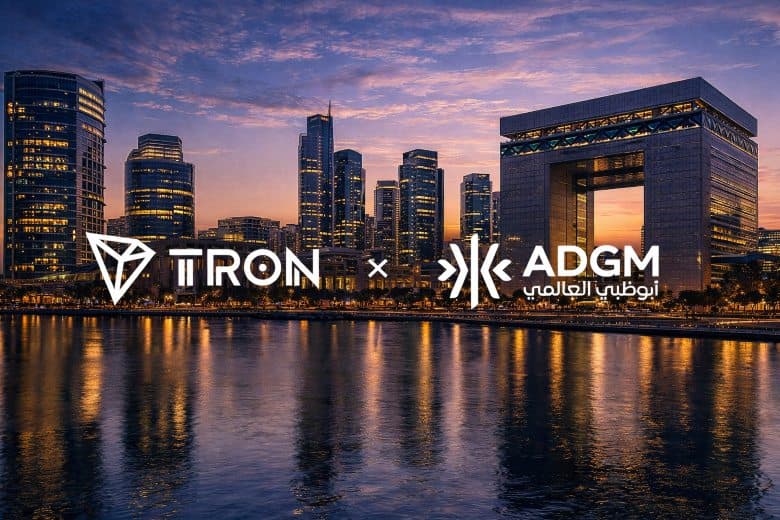
In a development that reads like the sequel to one of this year’s most talked-about stablecoin regulatory stories, the Abu Dhabi Global Market (ADGM) has now formally accepted USDT on the TRON blockchain as an Accepted Fiat-Referenced Token (AFRT) under its Financial Services Regulatory Authority (FSRA).
The announcement was confirmed in an X post by TRON DAO, highlighting that licensed Authorized Persons in ADGM can now use USDT on TRON in carrying out regulated activities.
This marks an important progression from the regulatory moment first covered by Unlock Blockchain in “Tether USDT in ADGM: A Win with a TRON Twist," an article that highlighted how early recognition of USDT in ADGM did not include TRON-minted supply, despite its outsized share of the global stablecoin market.
When ADGM initially recognized USDT as an accepted virtual asset under its framework, the absence of TRON-minted USDT was a noteworthy detail precisely because TRON hosted one of the largest portions of USDT issuance globally, a fact that colored interpretations of the UAE’s regulatory stance.
Today’s confirmation represents a full circle:
This shift is significant on several fronts:
For the UAE’s financial ecosystem, this development is more than a checkbox on a regulatory list. It highlights:
In short, what was once seen as a TRON-shaped gap in ADGM’s stablecoin policy is now an explicitly covered part of the jurisdiction’s regulatory regime, a material development for regional stablecoin utility and a noteworthy point of regulatory evolution for digital asset markets.
Beyond closing the “TRON Twist,” the FSRA’s decision further cements ADGM’s positioning as one of the world’s most advanced stablecoin regulators.
Under ADGM’s dedicated stablecoin framework introduced in 2024, Accepted Fiat-Referenced Tokens must meet strict criteria around full reserve backing, transparency, and anti-money laundering controls. Notably, the framework also allows yield-bearing stablecoins, enabling issuers to share income generated from reserves, a feature that remains rare among global financial centers.
USDT on TRON joins a growing list of AFRTs that already includes Circle’s USDC and Paxos-issued stablecoins, with USDT first gaining AFRT recognition across other major blockchains, including Ethereum, Solana, and Avalanche, earlier in December. TRON’s inclusion completes that multi-chain coverage.
TRON DAO framed the approval as validation not only of the network’s technical efficiency, but also its compliance posture. According to the organization, the FSRA’s acceptance reflects confidence in TRON’s governance standards and financial crime controls, including collaboration with global law enforcement through initiatives such as the T3 Financial Crime Unit, which targets illicit use of USDT on the network.
The broader implication is strategic. By approving USDT across multiple blockchains rather than privileging a single network, ADGM enables seamless movement of regulated liquidity across chains, improving capital efficiency for trading, payments, and custody services.
This approach has helped attract major global players. ADGM has issued more than 15 crypto-related licenses in recent years, with exchanges such as Binance and Kraken receiving full authorization, and stablecoin issuers like Circle securing Financial Services Permission to operate as Money Services Providers.
For stablecoin issuers, the clarity is equally important. Tether’s engagement with the FSRA reportedly involved detailed demonstrations of operational reserve management, reinforcing the regulator’s emphasis on transparency and systemic resilience.
As mentioned, this latest development also resolves the ambiguity first highlighted in “Tether’s USDT Recognized in ADGM: A Partial Win with a TRON Twist,” where USDT’s initial recognition in ADGM notably excluded TRON-minted supply despite the network’s dominant share of circulation. At the time, the omission raised questions around network-specific scrutiny and regulatory caution.
The FSRA’s subsequent acceptance of USDT on TRON as an AFRT now reframes that moment as transitional rather than exclusionary, suggesting not a permanent regulatory rejection, but a phased approach to stablecoin recognition that ultimately brought TRON-based USDT into ADGM’s regulated financial perimeter.
With TRON-based USDT now formally inside ADGM’s regulatory perimeter, the UAE’s stablecoin framework looks increasingly complete, interoperable, and institution-ready.
What began as a regulatory footnote has evolved into a clear signal: high-liquidity, multi-chain stablecoins are no longer peripheral to regulated finance in the region, they are foundational.

Disclaimer of Warranty
The information provided in this article is for general informational purposes only. We make no warranties about the completeness, reliability, and accuracy of this information. Read full disclaimer

Editor's Picks

Why Zondacrypto’s Collapse Would Unfold Differently in the UAE

Walid Abou Zaki

Aug 28, 2026

8 min

The Missing Orchestration Layer Holding Back Institutional Digital Assets
Julian Sawyer
Aug 18, 2026
5 min

Beyond Crypto Access: How ARP Digital Is Building the UAE’s Digital Capital Infrastructure
Anna K.
Aug 17, 2026
8 min
Read More Articles

In the Same Space

U.S. Bank Moves Its Stablecoin From Testing to Live Cross-Border Payment
News Desk
Sep 10, 2026
3 min

Visa Brings Onchain Credit to Stablecoin Card Financing
News Desk
Sep 9, 2026
3 min

A Swiss Franc Play in Europe’s Bank-Led Stablecoin Race
Salma Naueihed
Sep 9, 2026
5 min

Crypto Wealth Is Growing, but Traditional Wealth Infrastructure Is Not Ready
News Desk
Sep 10, 2026
4 min