Advertisement
Regulation & Policy
Share
The U.S. Securities and Exchange Commission’s emerging approach to tokenized securities is gaining political traction, as lawmakers on the House Financial Services Committee acknowledged that tokenization is increasingly becoming part of the future of U.S. capital markets, while also questioning how far regulators should go in carving out exemptions for blockchain-based assets.
At a Wednesday hearing titled “Tokenization and the Future of Securities: Modernizing Our Capital Markets,” members of the House Financial Services Committee debated whether U.S. securities rules are keeping pace with the growing push by both crypto-native firms and traditional market infrastructure providers to bring tokenized assets into regulated markets.
Republican lawmakers framed tokenization as an inevitable modernization trend. Representative Andy Barr said there is “no doubt” that tokenization of securities is already arriving, arguing that U.S. regulation now needs to evolve in a way that preserves investor protections while ensuring the country remains competitive in next-generation market infrastructure.
That framing increasingly aligns with the SEC’s own recent posture. While the agency has maintained that tokenized equities and similar blockchain-based instruments remain securities subject to federal law, it has also supported early-stage infrastructure pilots that could bring tokenized versions of traditional assets into existing regulated rails rather than outside them.
A key milestone came in December 2025, when the SEC granted the Depository Trust Company, a subsidiary of DTCC, a three-year no-action framework allowing it to offer tokenization services for a defined set of DTC-custodied assets on pre-approved blockchains. The authorization covers highly liquid instruments including Russell 1000 equities, major ETFs, and U.S. Treasuries, with DTCC stating that tokenized versions would retain the same ownership rights, investor protections, and entitlements as their traditional forms.
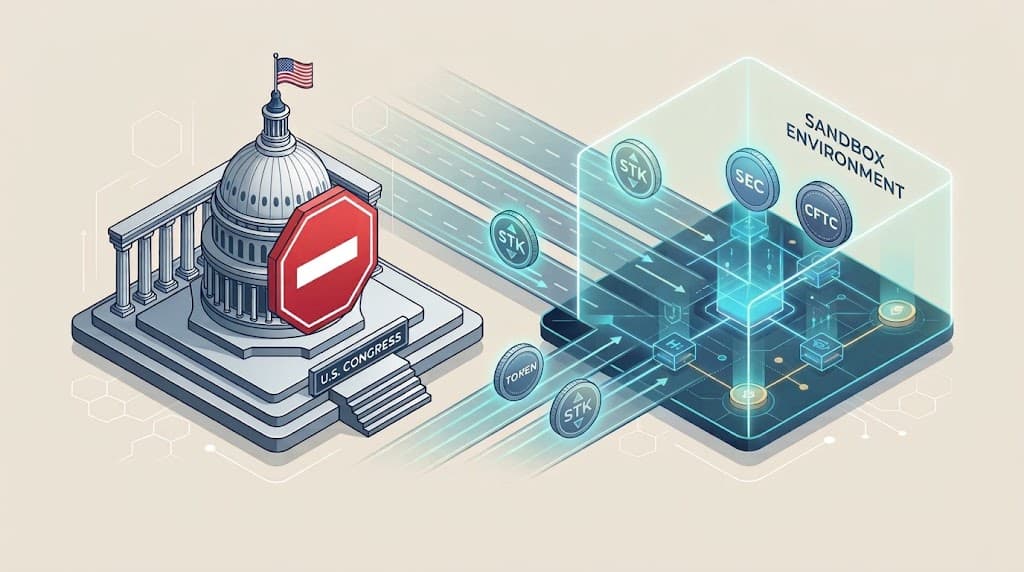
Against that backdrop, SEC Chair Paul Atkins is expected to seek public comment on a broader “innovation exemption” that could function as a limited regulatory sandbox for tokenized assets before formal rulemaking.
Institutional momentum behind tokenized securities has accelerated in 2026, reinforcing the view that tokenization is shifting from concept to market infrastructure.
Nasdaq recently announced its intention to launch an equity token design that would preserve issuer control and existing shareholder rights while enabling tokenized equity market infrastructure. The exchange said the initiative builds on its earlier SEC filing to enable securities to trade and settle in tokenized form through DTCC.
Meanwhile, the New York Stock Exchange has moved further into the space through a partnership with Securitize to develop a platform for blockchain-based securities issuance, trading, and transfer agency services. That initiative signals that tokenization is no longer being driven solely by crypto-native firms, but increasingly by core U.S. financial market operators.
Together, those developments suggest that tokenization is increasingly being positioned not as a replacement for securities law, but as a new settlement and ownership layer for familiar regulated assets.
Despite growing acceptance of tokenization’s direction, lawmakers made clear that the SEC’s proposed exemption remains politically sensitive.
Representative Brad Sherman warned that exemptive relief created through SEC action rather than explicit legislation could open the door to a two-tier market structure, where blockchain-based securities platforms operate under lighter obligations than traditional venues. His concerns reflect a broader policy divide over whether tokenization should be integrated through narrow pilots inside existing securities law or through more formal congressional redesign of the regulatory framework.
Top committee Democrat Maxine Waters struck a more skeptical tone, arguing that promises of efficiency and broader access must be weighed against whether tokenization genuinely benefits businesses and investors rather than primarily intermediaries. She also invoked the legacy of past financial engineering failures, comparing current enthusiasm for tokenization to pre-2008 narratives around securitization and financial innovation.
Waters also tied the discussion to ongoing concerns around President Donald Trump’s crypto-related conflicts of interest, arguing that public confidence in digital asset rulemaking could be undermined when policymakers or politically connected actors stand to benefit from the markets they are regulating.
While those remarks extend beyond the technical scope of tokenized securities, they reflect a broader challenge facing U.S. digital asset policymaking: trust in the rulemaking process itself. For regulators attempting to create a credible framework for tokenized markets, governance optics may prove nearly as important as the legal mechanics of exemptive relief.
Traditional finance groups remain cautious. The Securities Industry and Financial Markets Association (SIFMA), which represents major broker-dealers, banks, and asset managers, has consistently pushed for any SEC relief to proceed through transparent public consultation rather than bespoke exemptions. At the hearing, SIFMA President Kenneth Bentsen Jr. emphasized that the industry supports innovation, but only within the legal and regulatory framework already governing U.S. securities markets.
By contrast, digital asset advocates argue that regulatory clarity is becoming urgent as tokenization increasingly shifts from proof-of-concept to production-grade infrastructure. In prepared testimony, Blockchain Association CEO Summer Mersinger warned that absent clearer rules, development will continue abroad, potentially leaving U.S. markets behind in the next phase of financial infrastructure modernization.
This divergence captures the central tension in Washington’s tokenization debate: traditional finance wants clear guardrails before adoption scales, while digital asset firms argue that waiting too long risks ceding strategic leadership.
The policy debate now centers less on whether tokenization is coming, and more on how it will be integrated. For crypto firms, exchanges, and traditional market operators alike, the significance of the SEC’s proposed innovation exemption is that it could determine whether tokenized securities enter U.S. markets through tightly supervised pilots inside existing frameworks—or remain slowed by regulatory uncertainty while rival jurisdictions move faster.
For institutional markets, that distinction matters. Tokenization is increasingly being framed as a modernization layer for existing regulated assets rather than a parallel crypto-only system. The core question for Washington is whether the U.S. can support that transition without weakening the protections that underpin trust in public markets.

Disclaimer of Warranty
The information provided in this article is for general informational purposes only. We make no warranties about the completeness, reliability, and accuracy of this information. Read full disclaimer

Editor's Picks
In the Same Space

Stablecoin Yield Fight Helps Derail CLARITY Act in Senate

Walid Abou Zaki

Sep 15, 2026

8 min

Lunar Ark Secures VARA In-Principle Approval for Virtual Asset Brokerage
News Desk
Sep 17, 2026
2 min
NYSE and Blockchain.com Team Up to Expand Tokenized U.S. Stocks to Crypto Users
News Desk
Sep 24, 2026
4 min

UK Banks Complete First Interbank Transactions Using Tokenized Deposits
News Desk
Sep 24, 2026
4 min