Advertisement
Research & Analysis
Share
WA
CEO & Editor-in-Chief


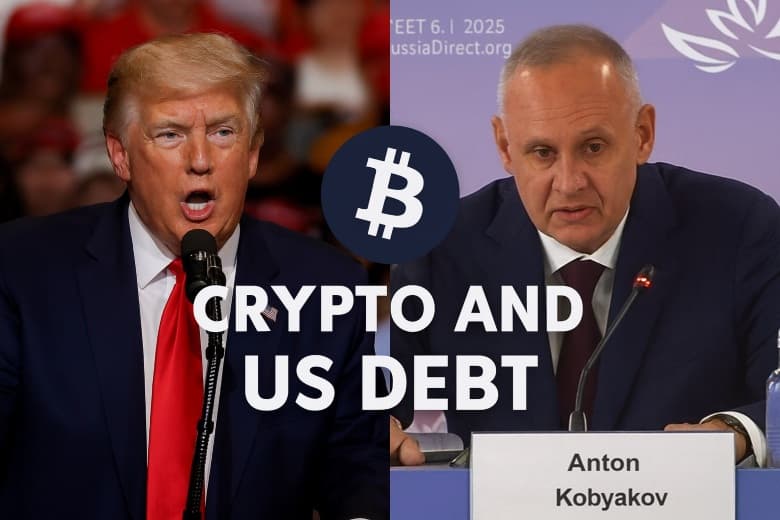
During a campaign rally, President Donald Trump made a curious remark: he suggested that the United States could one day “write on a piece of paper a few Bitcoin” to help pay down its towering national debt. Delivered in his trademark populist style, it wasn’t a detailed economic plan, but it revealed a symbolic shift—placing Bitcoin in the conversation about sovereign finance.
Fast forward to Vladivostok, September 6, 2025. At the Eastern Economic Forum, Anton Kobyakov, economic advisor to Russian President Vladimir Putin, issued a very different kind of statement. He warned that Washington might use stablecoins and gold to “rewrite the rules” of global finance, suggesting that part of the $37 trillion U.S. debt could be converted into digital assets in a move echoing past shifts off the gold standard.
Despite their opposing political positions, both men invoked crypto as part of America’s debt future.
Trump’s comments were lighthearted, but not accidental. They tapped into a growing belief that Bitcoin is a strategic reserve asset—a tool to hedge against inflation, dollar weakness, or geopolitical rivals. For his supporters, suggesting Bitcoin could help pay debt framed the U.S. as a nation bold enough to adopt new forms of value.
Yet even at today’s historic highs, with Bitcoin’s market capitalization around $2.25 trillion, the scale remains far below the size of U.S. debt. Trump’s line worked more as campaign theater than credible policy, but it showed how mainstream Bitcoin has become in American political discourse.
Kobyakov, by contrast, positioned crypto as a threat to global stability. He claimed the U.S. could attempt a “debt reset” by shifting liabilities into stablecoins, pushing systemic risks onto the rest of the world. He framed this as an evolution of earlier U.S. maneuvers—such as abandoning the gold standard in the 1930s and 1970s—moves that restructured debt while leaving others to absorb the costs.
In his view, stablecoins are not just private payment tokens but potential instruments of U.S. financial dominance, capable of reshaping the rules of the global system.
The difference between rhetoric and policy is striking. Since entering the White House in January 2025, Trump has moved from campaign lines to concrete action:
These steps don’t reduce debt directly, but they anchor crypto more firmly inside the U.S. financial stack.
While Kobyakov warned of stablecoins destabilizing global finance, the reality is the opposite: they strengthen U.S. financial power.
The two dominant issuers, Tether (USDT) and Circle (USDC), together account for more than $230 billion in circulation. With smaller players included, the global stablecoin market has reached around $300 billion. The majority of these reserves sit in short-term U.S. Treasury bills, which currently yield about 4–5%.
This structure generates billions in annual returns for issuers while simultaneously creating sustained demand for U.S. government debt. In effect, stablecoins act as a shadow channel of debt financing, tying global digital liquidity back to U.S. deficit spending.
Trump, running for office, portrayed crypto as an opportunity—a way to restore U.S. strength. Kobyakov, speaking on behalf of Moscow, portrayed it as a weapon—a way to destabilize rivals.
Both narratives are politically useful in their own contexts. Neither aligns perfectly with financial reality. But both demonstrate how crypto and stablecoins have moved from speculative assets into the geopolitical imagination.
Neither Bitcoin nor stablecoins are large enough to directly reset U.S. debt dynamics. And since stablecoins are built on dollar reserves and Treasuries, they reinforce the system more than they disrupt it.
What matters is not whether the U.S. can realistically pay down trillions with Bitcoin or stablecoins. It’s that both allies and adversaries are now speaking the language of digital assets in the same breath as sovereign debt.
This convergence reveals a deeper truth: crypto is no longer confined to trading floors and tech circles. It has entered the realm of sovereign strategy, where political narratives, financial innovation, and global power dynamics collide.
If U.S. politicians and Russian advisors both imagine crypto in sovereign debt strategies—one as salvation, the other as sabotage—how long before markets themselves start to price in that possibility?

Disclaimer of Warranty
The information provided in this article is for general informational purposes only. We make no warranties about the completeness, reliability, and accuracy of this information. Read full disclaimer

Editor's Picks
In the Same Space

OKX Extends Account-Hacking Protection to US Users

News Desk

Oct 21, 2026

3 min

Qafila 2026: Binance Looks Beyond the First Crypto Trade
Salma Naueihed
Oct 22, 2026
6 min

Fuze Finance Targets US Market With New Modern Treasury Stablecoin Payment Deal
Anna K.
Oct 20, 2026
6 min

Mastercard’s New Mission: Stop Stablecoin Fraud Before It Hits the Blockchain
News Desk
Oct 20, 2026
6 min