Advertisement
Markets
Share
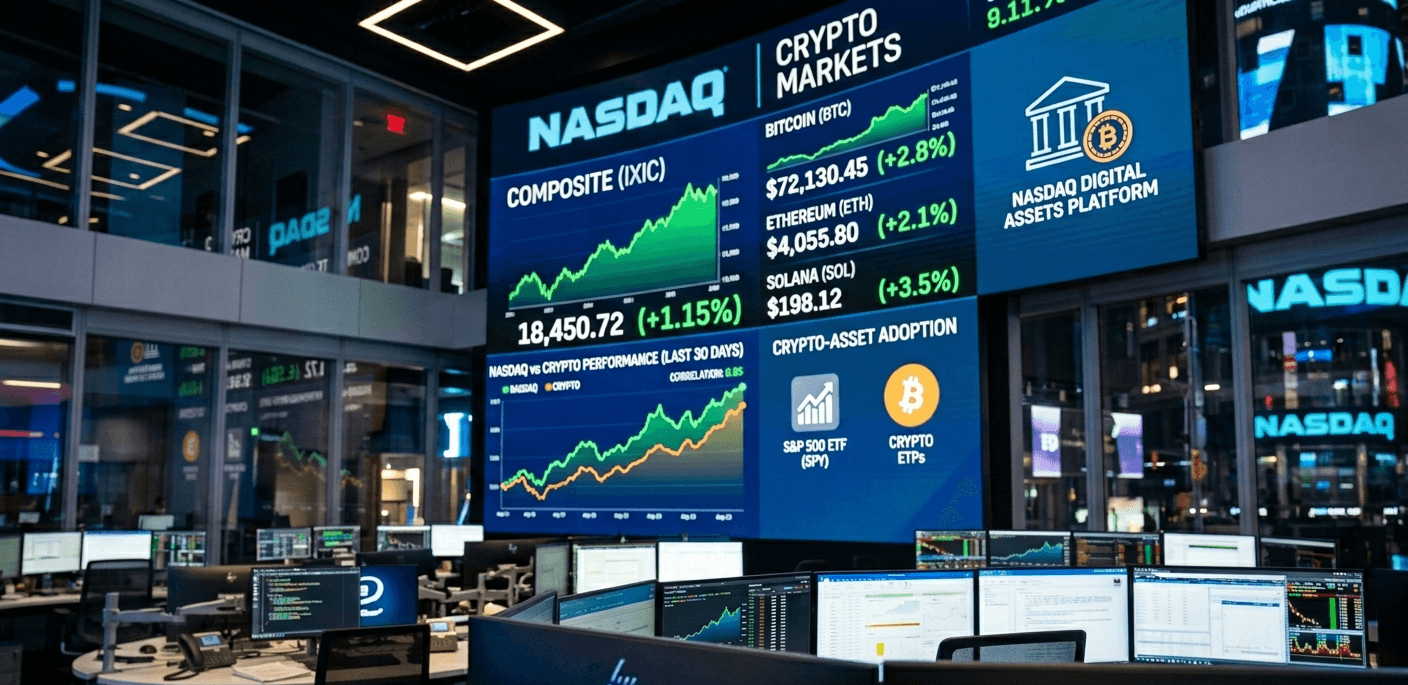
Nasdaq Inc. is expanding its push into digital assets through a new partnership with Talos, in a move that signals how cryptocurrency infrastructure is increasingly being integrated into the core systems of traditional financial markets.
The collaboration will connect crypto trading and risk management tools with the same infrastructure banks and brokers use to manage collateral, margin requirements, and market surveillance across traditional assets such as stocks and bonds. The initiative reflects a broader shift in financial markets, where digital assets are gradually being incorporated into existing financial systems rather than operating separately.
Under the partnership, Talos clients will gain access to Nasdaq’s Calypso platform, a system widely used by financial institutions to manage risk exposure, collateral, and margin requirements. By linking crypto trading infrastructure to these established financial tools, the companies aim to make digital assets easier for institutional investors to integrate into their existing workflows.
Talos provides trading and portfolio infrastructure for institutional investors, including hedge funds, brokers, and asset managers. By connecting its platform to Nasdaq’s infrastructure, institutions will be able to manage crypto positions alongside traditional assets within the same operational environment.
The move suggests that the gap between traditional finance and digital assets is narrowing, particularly as institutional investors demand integrated trading, risk management, and compliance systems.
Exchange operators are increasingly exploring ways to support round-the-clock trading across asset classes. Traditional stock markets operate on fixed trading hours, while cryptocurrency markets trade continuously. Integrating infrastructure across both markets could eventually allow financial assets to trade around the clock.
This convergence is one reason exchanges are exploring tokenization, the process of representing traditional financial assets such as stocks or bonds on blockchain networks. Tokenization could allow assets to be traded and settled continuously, similar to cryptocurrencies.
Both Nasdaq and the New York Stock Exchange have been exploring blockchain-based trading systems for tokenized assets, including tokenized equities and exchange-traded funds.
Tokenization is increasingly viewed as a potential solution to several inefficiencies in traditional markets, including settlement delays, collateral management, and limited trading hours. Supporters argue that tokenized assets could improve liquidity, reduce costs, and increase transaction efficiency.
Nasdaq has already been working on tokenized equity structures that would allow companies greater control over how their shares are represented and traded on blockchain networks. The exchange has also been collaborating with the parent company of crypto exchange Kraken on infrastructure designed to move tokenized equities between regulated trading venues and blockchain networks.
Regulatory developments are also moving in favor of tokenization. The U.S. Securities and Exchange Commission recently approved rule changes that could allow tokenized shares to be traded on regulated platforms, signaling growing regulatory acceptance of blockchain-based financial infrastructure.
Talos, which provides institutional digital asset infrastructure, has been expanding rapidly. The company recently raised additional funding that brought its total capital raised to approximately $150 million, with investors including major financial institutions and fintech companies such as Robinhood Markets Inc., BNY, and Fidelity.
The partnership between Nasdaq and Talos highlights a broader trend across global financial markets: digital assets are no longer being treated as a separate financial system but are increasingly being integrated into the infrastructure that supports traditional markets.
The integration of crypto trading, collateral management, and risk systems into traditional financial infrastructure suggests that the future of financial markets may involve a hybrid system where digital assets and traditional securities operate within the same technological and regulatory framework.
Rather than replacing traditional finance, blockchain technology and digital assets are increasingly being incorporated into existing market structures. As exchanges, regulators, and financial institutions continue building this infrastructure, the distinction between crypto markets and traditional markets may gradually disappear.
The partnership between Nasdaq and Talos is another sign that Wall Street is preparing for a financial system where digital assets, tokenized securities, and traditional financial instruments operate side by side within the same market infrastructure.

Disclaimer of Warranty
The information provided in this article is for general informational purposes only. We make no warranties about the completeness, reliability, and accuracy of this information. Read full disclaimer

Editor's Picks
In the Same Space
Binance Invests $100M in Circle, Extends USDC Partnership for Five Years

News Desk

Sep 22, 2026

2 min

JPMorgan Predicts Bitcoin Rally Against Gold Amid Shifting ETF Strategies
News Desk
Sep 18, 2026
3 min

Bitcoin ETFs Lose $288.7M in Fresh Wave of Investor Selling
News Desk
Sep 16, 2026
2 min

UK Banks Complete First Interbank Transactions Using Tokenized Deposits
News Desk
Sep 24, 2026
4 min