
Advertisement
Companies & Deals
Share

WA
CEO & Editor-in-Chief


Ethereum has long been considered the "oil" of the blockchain world, essential for fueling decentralized applications, smart contracts, and DeFi. Meanwhile, Bitcoin, as the "gold," dominates the narrative as the ultimate store of value. However, as Bitcoin flirts with the $100,000 milestone and Ethereum stagnates at $3,100, ETH holders are growing restless. The central question persists: will Ethereum’s role as the utility backbone of blockchain doom its holders to sacrifice price growth for modest staking rewards?
Ethereum remains foundational to the blockchain ecosystem, processing over 1.2 million daily transactions and hosting $60 billion in total value locked (TVL) across DeFi protocols. It powers the majority of dApps, from NFTs to decentralized exchanges, but its market performance has failed to keep pace with its technological dominance.
In 2021, during Bitcoin’s surge to $74,000, Ethereum traded at $4,100. Now, Bitcoin is nearing $100,000, while Ethereum has slumped to $3,100—a troubling disparity that reflects deeper issues within Ethereum's value proposition.
Ethereum’s transition to Proof of Stake (PoS) locked up over 33 million ETH, approximately 28% of its circulating supply, in staking contracts. While this secures the network and provides 3.3% annual yield, it limits liquidity. For many holders, this yield doesn’t compensate for missed opportunities in a rapidly evolving market, particularly as Bitcoin remains fully liquid and speculative.
While Ethereum remains active, its on-chain activity has cooled compared to its 2021 highs. Gas fees, once exceeding $50 per transaction, now average around $3, signaling reduced network congestion and demand. The NFT boom that once drove Ethereum activity has lost momentum, with trading volumes down over 70% year-over-year. Similarly, DeFi activity has slowed, reducing the revenue that once bolstered Ethereum’s ecosystem.
The blockchain space no longer belongs to Ethereum alone. Platforms like Solana, Avalanche, and Binance Smart Chain offer faster transactions at lower costs, luring developers and users.
Ethereum ETFs fail to capture the full value proposition of holding ETH. Unlike direct ETH holdings, which generate staking rewards of 3.3%, ETFs exclude these yields, leaving investors with only price exposure. This structural flaw has limited ETF adoption, particularly among institutional investors, making Ethereum ETFs less appealing than Bitcoin’s straightforward alternatives.
Ethereum’s staking mechanism has attracted regulatory scrutiny, particularly in the U.S., where authorities debate whether staking constitutes a securities offering. This uncertainty has deterred institutions, favoring Bitcoin, which enjoys regulatory clarity as a commodity.
Ethereum’s challenges are not insurmountable, but decisive actions are required to align its utility with market performance:
As Bitcoin's meteoric rise fuels FOMO , Ethereum holders face a stark choice: remain loyal to Ethereum’s long-term vision or chase short-term profits in other assets. For instance:
This trade-off is becoming increasingly difficult to justify, especially as Ethereum’s competitors offer more lucrative short-term opportunities.
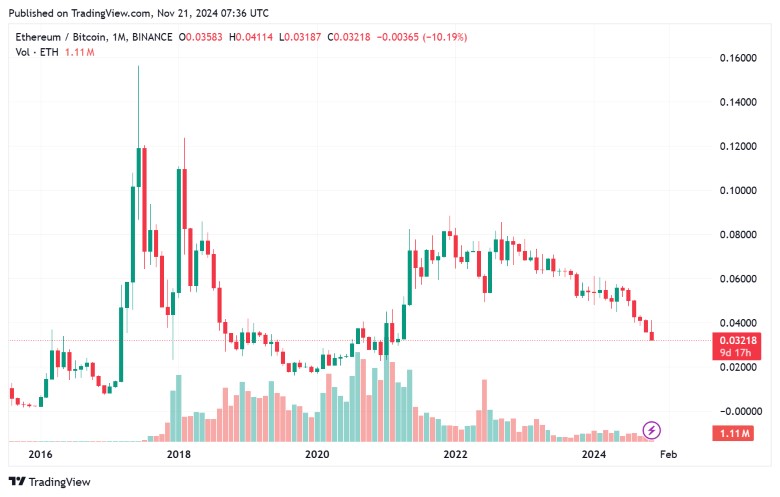
Ethereum’s leadership, particularly Vitalik Buterin, faces a critical moment. While Ethereum’s technological advancements and decentralized ethos remain unmatched, these strengths alone may no longer be enough to retain its user base and investor confidence. With Bitcoin dominating headlines and other blockchains gaining traction, Ethereum risks losing both its market position and the loyalty of its holders.
The challenge is clear: Ethereum needs to realign its value proposition with the expectations of its community and investors. That means delivering tangible outcomes that go beyond its role as the “oil” of blockchain. Simply sustaining the network is not enough. Holders want to see a balance between Ethereum’s long-term vision and short-term incentives—whether through higher staking rewards, better liquidity options, or faster scaling solutions.
Failing to act decisively risks a critical outcome: Holders may abandon Ethereum’s vision to chase immediate profits elsewhere. For all its potential, Ethereum’s future depends on whether it can convert belief into tangible rewards that justify the patience of its community.

Disclaimer of Warranty
The information provided in this article is for general informational purposes only. We make no warranties about the completeness, reliability, and accuracy of this information. Read full disclaimer

Editor's Picks

When Assets Move—or Stop—Without Consent: The Limits of Crypto Wallet Control

Walid Abou Zaki

Sep 29, 2026

6 min

Where Do the Dollars Behind the UAE’s Crypto Economy Sit?
Anna K.
Sep 21, 2026
9 min

As U.S. Crypto Legislation Stalls, Circle Launches Its Own Financial Network
Walid Abou Zaki
Sep 16, 2026
9 min
Read More Articles

In the Same Space

MiCA Stablecoin Rules Face a Reality Check as Circle Calls for Change
Walid Abou Zaki
Oct 5, 2026
11 min

Hong Kong Prepares to Rewrite the Rules for Virtual Assets, Licensing Bill Planned for 2026
News Desk
Oct 5, 2026
4 min

S&P Global Takes On DeFi’s $10B Lending Boom With New Risk Framework
News Desk
Oct 5, 2026
4 min

UAE FIU and VARA Join Forces to Crack Down on Virtual Asset Crime
News Desk
Oct 5, 2026
3 min