Advertisement
Regulation & Policy
The approval follows Bybit’s earlier federal UAE license, while derivatives remain subject to further regulatory authorization.
Share
WA
CEO & Editor-in-Chief


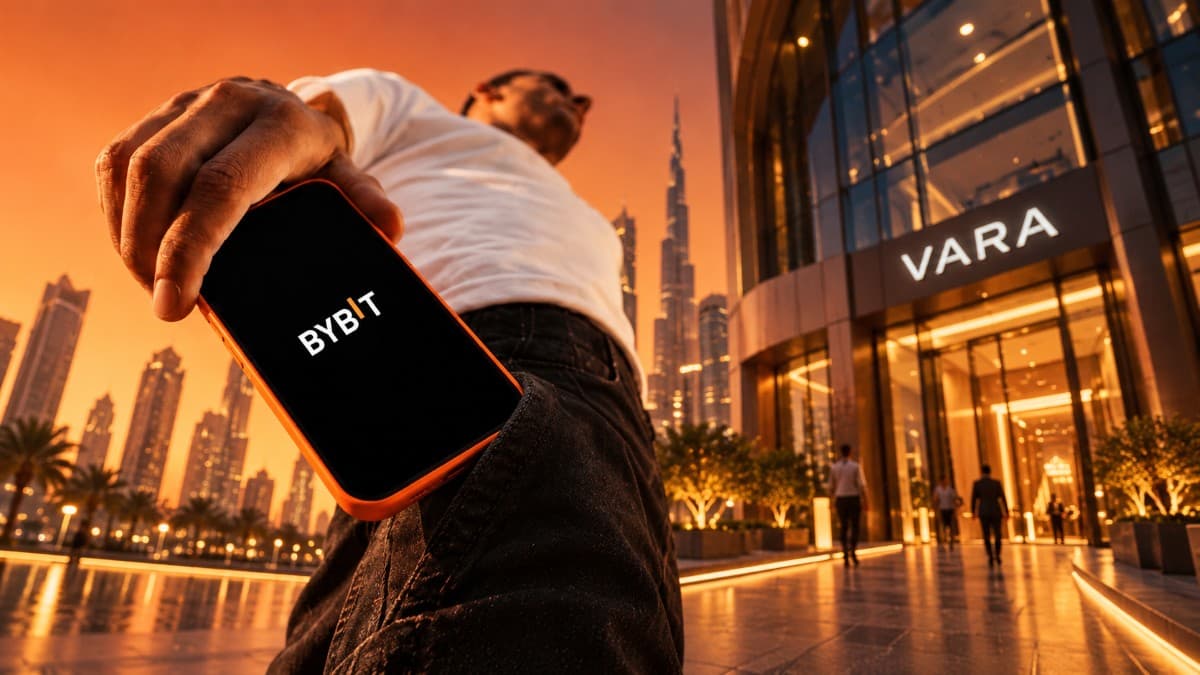
VARA has granted Bybit Fintech FZE a full VASP license for spot trading Exchange Services in Dubai, more than two years after the company's August 2024 in-principle approval and eight months after it secured a separate federal operating license from the CMA.
Dubai’s Virtual Assets Regulatory Authority (VARA) has granted Bybit Fintech FZE a Virtual Asset Service Provider license for Exchange Services covering spot trading, according to an announcement from the company.
The approval marks a new stage in Bybit’s UAE regulatory journey. The company initially pursued authorization in Dubai, subsequently secured a federal operating license, and retained its VARA in-principle approval throughout.
With the Dubai process now reaching a VASP license, attention turns to what this approval enables Bybit to pursue beyond its existing federal authorization—and how it fits into the company’s wider product plans.
Bybit’s Dubai licensing process preceded its federal authorization. VARA’s public register recorded an in-principle approval for Bybit Fintech FZE dated August 21, 2024, covering Exchange Services.
The company announced that approval in September 2024, describing it as provisional and non-operational, with further requirements to be completed before receiving full operational authorization.
An IPA represents a conditional stage in the licensing process. It does not itself authorize an applicant to begin regulated virtual asset operations.
Bybit’s Dubai application subsequently remained under IPA as the company advanced through a separate federal licensing process.
Bybit announced in February 2025 that it had received in-principle approval from the Securities and Commodities Authority (SCA), the federal regulator now known as the Capital Market Authority (CMA). According to the company’s announcement, that approval was dated February 18, 2025.
The full federal license followed in October 2025.
As Unlock Blockchain reported at the time, Bybit said it had become the first global crypto platform to obtain a federal Virtual Asset Platform Operator license. The company outlined plans for trading, brokerage, custody and fiat conversion services, alongside an expanded regional operations center in Abu Dhabi.
That announcement established a federal operating route for Bybit. It also left an outstanding question about the future of its Dubai application.
Unlock’s October coverage asked whether Bybit would eventually withdraw its VARA application or continue pursuing the Dubai route alongside its federal authorization.
The continued presence of Bybit’s IPA became a recurring detail in its UAE regulatory story.
In its coverage of VARA–SCA alignment in October 2025, Unlock reported both authorities’ emphasis on cooperation, while noting that Bybit’s specific operational and supervisory arrangements had not been publicly detailed.
Later that month, Unlock examined Bybit’s Abu Dhabi-focused recruitment following the federal license. The article also noted that its VARA IPA remained on the register.
By January 2026, the Dubai application was still in place.
In its review of VARA’s licensing pipeline, Unlock highlighted that Bybit continued to hold its August 2024 IPA despite having obtained federal authorization. Its continued presence suggested that the Dubai route remained open.
Bybit has now announced that the process has reached a VASP license, more than two years after the IPA date.
The company identifies spot trading as the activity covered by Bybit Fintech FZE’s Exchange Services license.
“Dubai has made significant progress in building a regulatory environment for virtual assets, and we are pleased to take this next step in our journey here,” said Ben Zhou, Bybit’s co-founder and CEO.
“We look forward to continuing our work in Dubai, supporting the local digital asset community and building our business in line with the standards set by VARA.”
Bybit maintains its international headquarters in Dubai. Its latest statement emphasizes its continued presence in the emirate, but does not provide a launch timetable for the locally licensed service or detail its initial product offering.
Alongside Zhou’s comments, Bybit’s announcement includes a statement from Peter Loo, its chief legal and compliance officer, setting out what the company hopes to pursue beyond the spot trading approval.
“In time, we also hope to expand our licensed activities to include derivatives, subject to the necessary regulatory approvals,” Loo said.
“Derivatives are a major part of Bybit’s global trading business, and we want to bring more of our offering to Dubai through the appropriate regulatory process.”
His comments place the spot license within a wider commercial ambition. Bybit has completed a long-running Dubai licensing milestone, while a major component of its global offering remains subject to further approval in Dubai.
The announcement does not provide a timetable for that expansion or explain how the proposed Dubai derivatives business would fit alongside its existing federal authorization.
The Dubai approval arrives shortly after Zhou’s October keynote, which outlined Bybit’s expansion across cryptocurrency trading, traditional financial markets, payments and AI-assisted services.
The company’s keynote materials described recently launched access to more than 1,000 U.S. stocks and ETFs for eligible users, alongside its existing derivatives products.
Bybit also outlined plans for mStocks, a stock-backed token initiative being developed with Mantle and targeted for November. Under the proposed model, eligible shares could be converted into tokens backed one-to-one by stocks, used in supported on-chain markets or as trading collateral, and converted back into shares.
Those conversion and collateral capabilities remain part of the company’s planned development. Its current Stocks guide states that ordinary stock holdings are not used as margin collateral within the Unified Trading Account.
The presentation also covered Bybit AI, which supports account information, customer service and supported trading actions through a conversational interface, with user confirmation required before financial actions are executed.
Together, these developments describe a business extending beyond its original cryptocurrency exchange offering. The Dubai licensing announcement does not specify which of those wider services would be available through Bybit Fintech FZE.
Bybit’s decision to complete the VARA process suggests that its federal authorization alone did not provide everything the company needed for the next phase of its UAE business.
The company had already secured a full federal operating license. Yet its Dubai application remained open, and it has now obtained VARA approval after more than two years under IPA.
What additional capabilities is Bybit seeking through VARA, and what made completing this process important at this stage?
Loo’s comments provide some context. Derivatives represent a major part of Bybit’s global business, and the company explicitly wants to bring more of that offering to Dubai, subject to further approval.
Combined with Zhou’s broader product roadmap, the announcement raises a question that the release leaves unanswered: what does the VARA route enable Bybit to pursue beyond what it could already deliver under its federal authorization?

Disclaimer of Warranty
The information provided in this article is for general informational purposes only. We make no warranties about the completeness, reliability, and accuracy of this information. Read full disclaimer

Editor's Picks
In the Same Space
3iQ Secures In-Principle ADGM Approval for UAE Expansion

News Desk

Oct 12, 2026

3 min

Philippines’ Largest Crypto Exchange Faces License Threat Over Gambling Links
News Desk
Oct 14, 2026
3 min

OKX UAE Adds Tokenized U.S. Stocks to Its VARA-Regulated Platform
Anna K.
Oct 12, 2026
4 min

Standard Chartered Extends Crypto Trading to UAE Wealth Clients
News Desk
Oct 14, 2026
3 min