Advertisement
Exchanges & Trading
Share
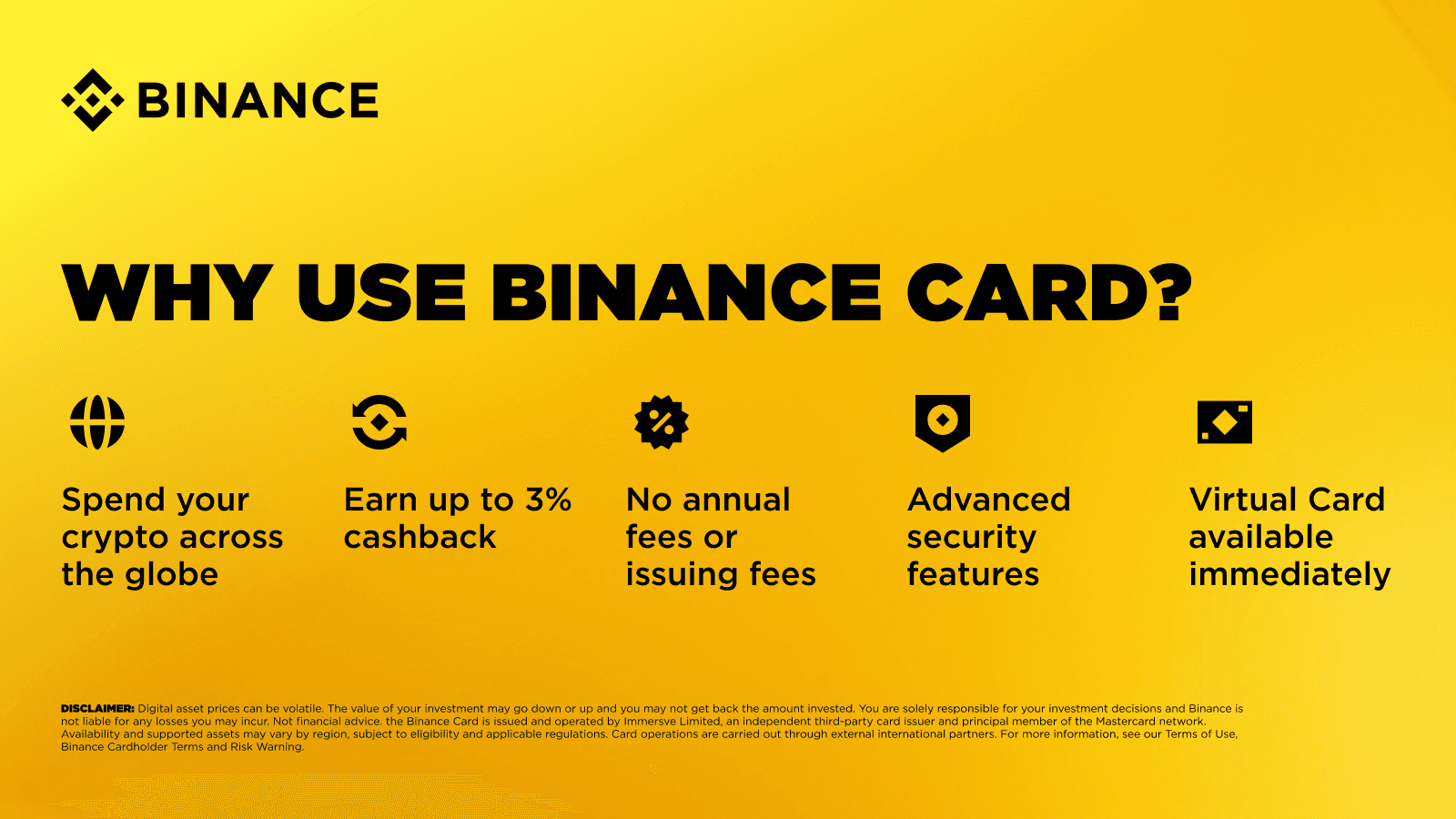
Binance, the global blockchain ecosystem behind the world’s largest cryptocurrency exchange by trading volume, is continuing to scale its Binance Card, a payments solution designed to bridge digital asset balances with everyday spending.
Developed in partnership with Mastercard, the card allows users to make purchases at millions of merchants worldwide by converting supported cryptocurrencies into local fiat currency in real time at the point of transaction.
The initiative reflects a broader push within the digital asset industry to move beyond trading-centric use cases and toward functional payment integration within existing financial infrastructure.
The Binance Card enables users to spend directly from their Binance account balances without the need for manual conversion or external transfers. Transactions are automatically settled in fiat currency, creating a payment experience that mirrors conventional debit card usage while maintaining exposure to digital assets.
Supported assets include USDT, USDC, FDUSD, BNB, BTC, ETH, SOL, ADA, LINK, and XRP, allowing users to allocate a broad range of crypto holdings for everyday transactions.
To encourage adoption, Binance offers up to 3% cashback on eligible purchases, positioning the card not only as a utility tool but also as a value-added spending mechanism within its broader ecosystem.
The company has framed the product as part of its strategy to increase real-world utility for digital assets, particularly as user demand shifts toward practical financial applications rather than speculative trading alone.
A key feature of the Binance Card is its real-time conversion mechanism, which automatically exchanges crypto holdings into local currency at the point of sale. This removes operational friction for merchants while maintaining compatibility with existing payment rails supported by Mastercard.
This hybrid structure reflects a growing trend in the payments sector where blockchain-based assets are integrated into traditional financial systems rather than operating in isolation.
The expansion of the Binance Card aligns with a broader industry transition toward embedded crypto payments, as exchanges and infrastructure providers seek to expand beyond trading and custody services.
In this model, digital assets increasingly function as a settlement layer for consumer transactions, rather than solely as investment instruments. The integration with Mastercard underscores the continued convergence between legacy payment networks and blockchain-native financial systems.
Binance positions the card as part of its wider ecosystem strategy aimed at improving access to digital assets and expanding their real-world applicability. By connecting crypto balances directly to global merchant infrastructure, the company is reinforcing its role in enabling consumer-facing blockchain finance.
As competition intensifies across the digital payments landscape, crypto-linked card products are emerging as a key battleground for mainstream adoption, particularly in regions where users seek seamless conversion between digital assets and fiat currencies.

Disclaimer of Warranty
The information provided in this article is for general informational purposes only. We make no warranties about the completeness, reliability, and accuracy of this information. Read full disclaimer

Editor's Picks

Why Zondacrypto’s Collapse Would Unfold Differently in the UAE

Walid Abou Zaki

Aug 28, 2026

8 min

The Missing Orchestration Layer Holding Back Institutional Digital Assets
Julian Sawyer
Aug 18, 2026
5 min

Beyond Crypto Access: How ARP Digital Is Building the UAE’s Digital Capital Infrastructure
Anna K.
Aug 17, 2026
8 min
Read More Articles

In the Same Space
Standard Chartered Brings Institutional Bitcoin, Ether Trading to UAE
Salma Naueihed
Sep 3, 2026
4 min

Iran Turns to Crypto as Sanctions Bite, But USDT Has a Control Problem
Salma Naueihed
Sep 9, 2026
5 min

DDSC and Network International Launch UAE’s First In-Store AED Stablecoin Pilot
News Desk
Sep 9, 2026
2 min
A Swiss Franc Play in Europe’s Bank-Led Stablecoin Race
Salma Naueihed
Sep 9, 2026
5 min