
Advertisement
Web3 & Development
Share
Meta's CEO, Mark Zuckerberg, joined forces with AI researcher Lex Fridman to showcase the incredible capabilities of Meta's metaverse technology.
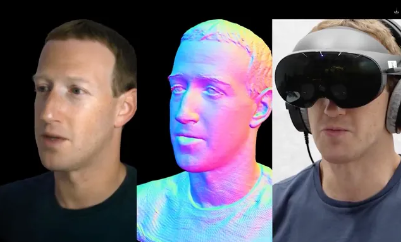
They unveiled "codec avatars," digital replicas that intricately capture facial expressions and body language, creating an astonishing sense of presence and intimacy.
Fridman was awestruck, describing it as the most remarkable experience he's encountered, akin to an in-person conversation.
This breakthrough represents Meta's bold vision, melding AI with immersive virtual and augmented reality to craft the "metaverse," a digital parallel reality driven by computing power.
These hyper-realistic avatars surpass the rudimentary characters Meta introduced last year, transcending the uncanny valley to offer familiarity and comfort as immersion deepens.
Meta is placing a substantial bet on integrating AI into both software and hardware, fostering richer social interactions through extended reality platforms.
As Meta CTO Andrew Bosworth emphasized, AI is the driving force behind the metaverse's evolution. The recent Meta Connect conference showcased major strides in multimodal AI, introducing MetaAI, an AI companion that works seamlessly with forthcoming smart glasses, enabling hands-free interaction and real-world object recognition.
In a two-hour podcast, Zuckerberg delved into AI's pivotal role in Meta's array of products and services, underlining its significance in understanding metaverse content, context, and platform enhancement. The commitment to advancing AI research and development, as well as sharing insights with the open-source community, was a recurring theme.
Zuckerberg also envisions a future where photorealistic avatars redefine self-expression, unshackling users from their physical reality and transforming how they interact. These avatars hold the potential to revolutionize remote work, gaming, and social interactions, forging deeper connections and a stronger sense of presence.
Addressing challenges and controversies, such as censorship, privacy, security, mental health, and competition, Zuckerberg acknowledged Meta's responsibility for its societal impact and the imperative to refine policies and practices continually. He welcomed constructive input from users, regulators, and experts.
Meta charges ahead with AI-driven personas and immersive extended reality hardware, with a grand vision of the metaverse and ubiquitous AI. While technological and social obstacles persist, Zuckerberg's belief in AI-driven authenticity and realism remains unwavering.
Meta's determined focus centers on building the foundational technologies, step by nimble step, to bring this sci-fi vision to life.

Disclaimer of Warranty
The information provided in this article is for general informational purposes only. We make no warranties about the completeness, reliability, and accuracy of this information. Read full disclaimer

Editor's Picks
In the Same Space

ESMA Assesses Liquidity and Legal Risks of Tokenized Collateral

News Desk

Oct 9, 2026

6 min

Trump Launches $215M Quantum Computing Competition Amid Crypto Risks
News Desk
Oct 9, 2026
6 min

Sui's Hashi Network to Unlock Bitcoin Lending With $500 Million in Commitments
News Desk
Oct 9, 2026
5 min

US Government Transfers 12,267 BTC Worth $1 Billion in Latest Bitcoin Move
News Desk
Oct 9, 2026
5 min