Advertisement
Web3 & Development
Share
Samsung Electronics has filed a US patent for a digital-asset wallet system that uses smart contracts and multi-device architecture to handle wallet functions without requiring devices to directly access private keys, potentially reducing the technical burden of self-custody.
Samsung Electronics has filed a US patent for a digital-asset wallet system that could allow devices to initiate cryptocurrency transactions without directly handling the private key used to authorize them.
The patent describes a wallet architecture that shifts some key functions away from individual devices and into a smart contract on a blockchain network. The approach could reduce the amount of sensitive wallet information users need to manage on each device while enabling several devices to interact with the same digital-asset infrastructure.
According to a report by Digital Asset, the patent was published in the US on July 23 under application number US 2026/0212355. Patent records show that Samsung Electronics filed the application on March 13, 2026.
The proposed system is built around a smart contract that handles part of the wallet's functionality on the blockchain rather than leaving all wallet operations to the device itself.
Under the architecture described in the patent, a device requesting a transaction would not necessarily need to store or directly use the private key associated with the smart-contract address. The transaction could instead be processed through the contract infrastructure, with authentication information and wallet functions managed through the blockchain-based system.
The design does not eliminate private keys altogether. Samsung's filing indicates that transactions can still depend on the smart-contract address and the corresponding private key. The difference is that the device initiating the transaction would not necessarily need direct access to that key.
That distinction addresses one of the longstanding challenges of self-custody.
Traditional self-custody wallets place responsibility for private-key security on the user. Losing the key can mean losing access to the associated assets, while exposing it to another party can give that party control over the wallet.
Samsung's patent identifies the management of such sensitive information as a limitation of existing wallet structures. At the same time, moving key management entirely to a centralized service introduces another set of risks, including hacking, service outages and dependence on a single provider.
The proposed architecture attempts to sit between those models by using smart contracts and multiple devices to manage wallet-related functions.
Samsung's concept also extends beyond a single smartphone or computer.
The patent describes a system in which multiple electronic devices can participate in creating, modifying or recovering the addresses used for digital-asset transactions.
One device could request that a transaction be executed, while another could perform functions such as registering a new device or recovering an address. Once the process is completed, the new address and associated authentication information could be recorded through the smart contract.
The system could potentially support a range of Samsung-connected devices, including smartphones, computers, wearable devices and home appliances.
That multi-device architecture could give users greater flexibility in how they access and manage digital assets while reducing reliance on a single device as the gateway to a wallet.
The patent builds on Samsung's previous efforts to incorporate blockchain and digital-asset functionality into its consumer ecosystem.
Galaxy smartphones have supported Samsung Blockchain Wallet and blockchain key-management functionality for several years. The company has also previously integrated Ledger hardware wallets with Galaxy devices, allowing users to manage assets held through supported hardware wallets from their smartphones.
Samsung has continued expanding its digital-asset services within its mobile ecosystem.
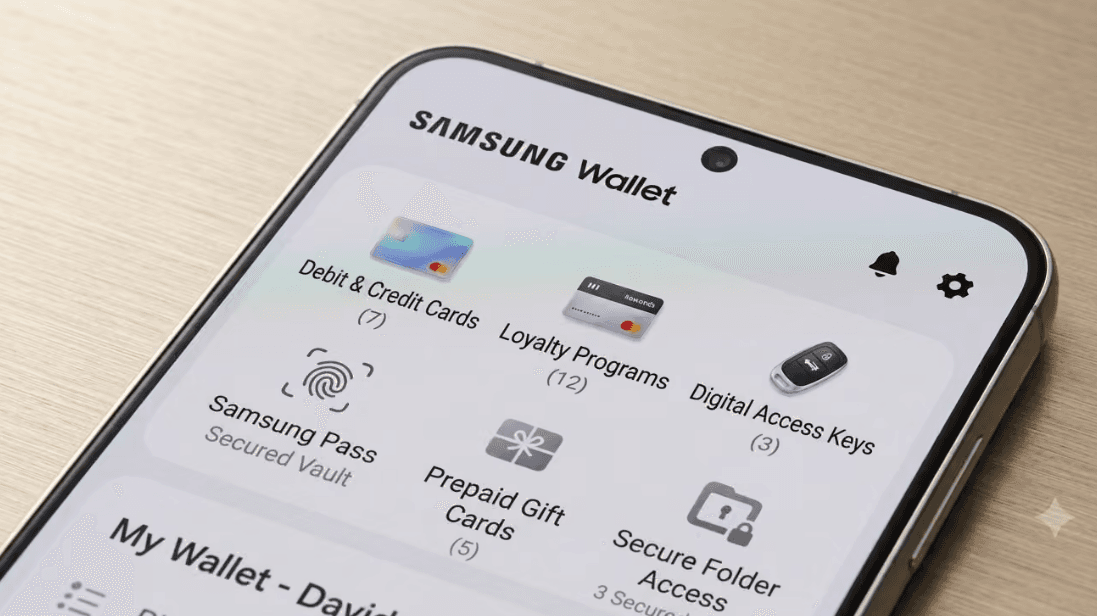
In 2025, the company integrated Coinbase services into Samsung Wallet for Galaxy users in the US, giving eligible customers access to cryptocurrency services through the wallet.
The latest patent suggests that Samsung's interest extends beyond simply giving users access to existing crypto services. The company is also exploring how wallet architecture itself could be redesigned around blockchain-based authentication and smart-contract infrastructure.
Samsung's patent also fits into a broader technology-industry interest in digital assets and blockchain infrastructure.
Companies including Meta, Google and Microsoft have explored different applications of blockchain, digital assets and related technologies, ranging from infrastructure and cloud services to payments and enterprise applications.
That broader shift is changing the role technology companies can play in the digital-asset market.
Rather than simply offering access to cryptocurrencies, technology firms are increasingly looking at wallets, payments, identity, custody and the underlying infrastructure through which digital assets can be managed.
For consumer technology companies, that creates an opportunity to integrate digital assets directly into devices and everyday services rather than treating crypto as a separate financial product.
Samsung's patent points towards a different model for wallet security in which the user does not necessarily have to interact directly with a private key every time a transaction is initiated.
Instead, authentication, address management and transaction functions could be distributed across smart contracts and multiple connected devices.
If developed into a commercial product, the approach could address one of the biggest barriers to self-custody: the technical complexity of managing private keys. At the same time, it could preserve more user control than models that depend entirely on centralized custodians.
The patent does not establish that Samsung will launch such a wallet, nor does it provide a timeline for a commercial product. But it does show where the company's digital-asset research is heading: towards making blockchain functionality less dependent on users directly managing cryptographic credentials and more deeply integrated into the devices they already use.

Disclaimer of Warranty
The information provided in this article is for general informational purposes only. We make no warranties about the completeness, reliability, and accuracy of this information. Read full disclaimer

Editor's Picks

When Assets Move—or Stop—Without Consent: The Limits of Crypto Wallet Control

Walid Abou Zaki

Sep 29, 2026

6 min

Where Do the Dollars Behind the UAE’s Crypto Economy Sit?
Anna K.
Sep 21, 2026
9 min

As U.S. Crypto Legislation Stalls, Circle Launches Its Own Financial Network
Walid Abou Zaki
Sep 16, 2026
9 min
Read More Articles

In the Same Space
Goldman Puts Traditional Treasury Fund on Crypto’s Institutional Rails
News Desk
Sep 29, 2026
4 min

Canada’s Big Six Banks Explore Tokenized Deposit System
News Desk
Sep 23, 2026
5 min
SoFi Becomes First National Bank to Launch Stablecoin Settlement
News Desk
Sep 23, 2026
4 min

UAE Tokenized Deposits Are Moving Faster Than Stablecoins
Walid Abou Zaki
Oct 6, 2026
10 min