Advertisement
Tokenization Infrastructure
Share
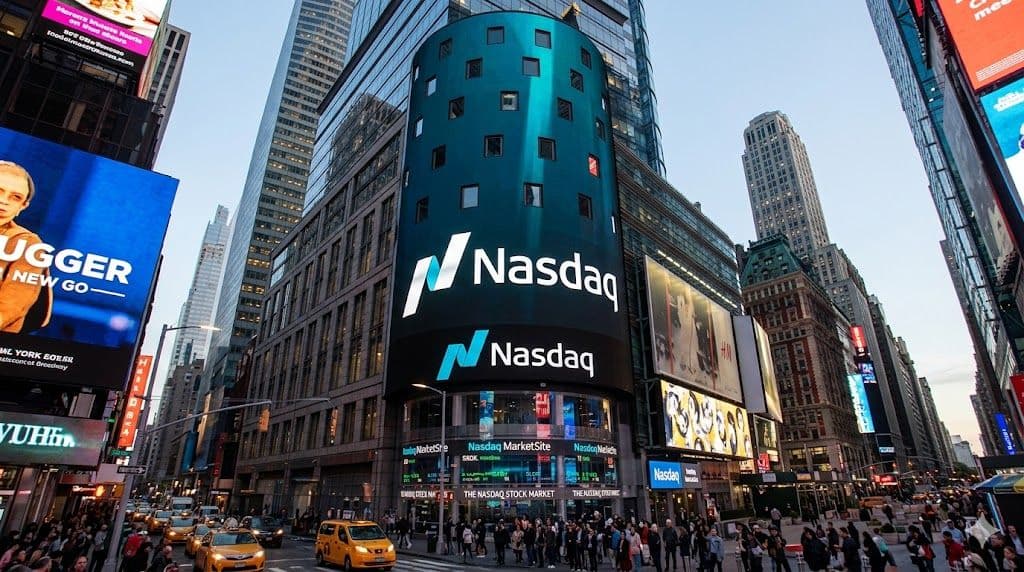
Nasdaq has announced a collaboration with Payward, the parent company of cryptocurrency exchange Kraken, to develop infrastructure for tokenized equities, reflecting growing institutional interest in blockchain-based financial markets.
The New York-based exchange operator said the initiative will focus on enabling tokenized versions of stocks and exchange-traded products while maintaining the governance and shareholder rights associated with traditional securities.
Nasdaq said the framework is expected to launch in early 2027. The initiative will allow issuers to offer tokenized versions of their securities, giving holders governance rights equivalent to investors who own the underlying shares.
Under the plan, the exchange will explore ways to simplify corporate governance processes, including proxy voting, shareholder engagement, and corporate actions such as dividend distributions.
The framework will be open to issuers that choose to participate, including companies not currently listed on Nasdaq.
Kraken will act as a distribution partner for the initiative, enabling access to one-to-one tokenized versions of public company shares for its customers in Europe and other international markets.
As part of the collaboration, Nasdaq will use Payward’s xStocks tokenization platform to support the movement of securities from traditional institutional trading infrastructure to blockchain networks.
The development follows another recent milestone for Kraken in the U.S. financial system. Kraken Financial, the Wyoming-chartered banking subsidiary of the exchange, recently became the first U.S. digital asset bank to gain access to the Federal Reserve’s payment system through a limited-purpose master account. The move allows the firm to connect directly to U.S. payment rails under its specialized banking charter.
Separately, Nasdaq also announced a partnership with German exchange operator Boerse Stuttgart to connect with its tokenized settlement platform. The collaboration aims to facilitate trading and settlement of blockchain-based equities across European markets.
Nasdaq’s announcement builds on a proposal submitted to the U.S. Securities and Exchange Commission in September. The exchange operator sought approval to allow investors to trade securities listed on Nasdaq in either traditional digital form or tokenized form within the same exchange environment.
Under the proposal, high-volume stocks such as Nvidia or Tesla could be traded either as conventional shares or as blockchain-based tokens. Both formats would share the same CUSIP identifier, ensuring that they remain interchangeable and settle through the Depository Trust, which processes a large share of U.S. equity trades.
The proposal remains subject to final approval by the SEC.
Institutional interest in digital asset infrastructure has increased following the passage of the Guiding and Establishing National Innovation for U.S. Stablecoins (GENIUS) Act last year, although broader digital asset regulation in the United States is still under discussion.
Other major financial institutions and technology platforms have also begun exploring tokenized securities.
In January, Intercontinental Exchange — the parent company of the New York Stock Exchange — said it was seeking regulatory approval for a blockchain-based platform designed to enable 24/7 trading and on-chain settlement of tokenized securities.
Several crypto platforms have already introduced tokenized equity products in international markets. Robinhood, Gemini, and Kraken have launched tokenized stock offerings in Europe, while Coinbase and startup Dinari are pursuing regulatory approval for similar services in the United States.
Despite the expansion of tokenization initiatives, investor sentiment toward digital assets remains divided. Bitcoin continues to trade near levels seen before the 2024 U.S. presidential election, highlighting ongoing debate over the role cryptocurrencies should play in investment portfolios.
Tal Cohen, president of Nasdaq, said tokenization could reshape how market participants interact with financial infrastructure.
“Tokenization has the potential to unlock the benefits of an always-on financial ecosystem — enhancing how investors access markets and how issuers engage with shareholders,” Cohen said.

Disclaimer of Warranty
The information provided in this article is for general informational purposes only. We make no warranties about the completeness, reliability, and accuracy of this information. Read full disclaimer

Editor's Picks
In the Same Space

Börse Stuttgart Secures DLT License for Seturion Settlement Platform

News Desk

Oct 21, 2026

3 min
Tokenized Stocks Hit a Wall as Corporate Resistance Grows, What's Happening?
News Desk
Oct 19, 2026
5 min

Bitcoin ETFs Reverse Outflows With $1B in Three-Day Inflows
News Desk
Oct 22, 2026
7 min

Robinhood Plans Dubai Launch in 2027 After DFSA Authorization
Walid Abou Zaki
Oct 22, 2026
4 min