
Advertisement
Web3 & Development
Share
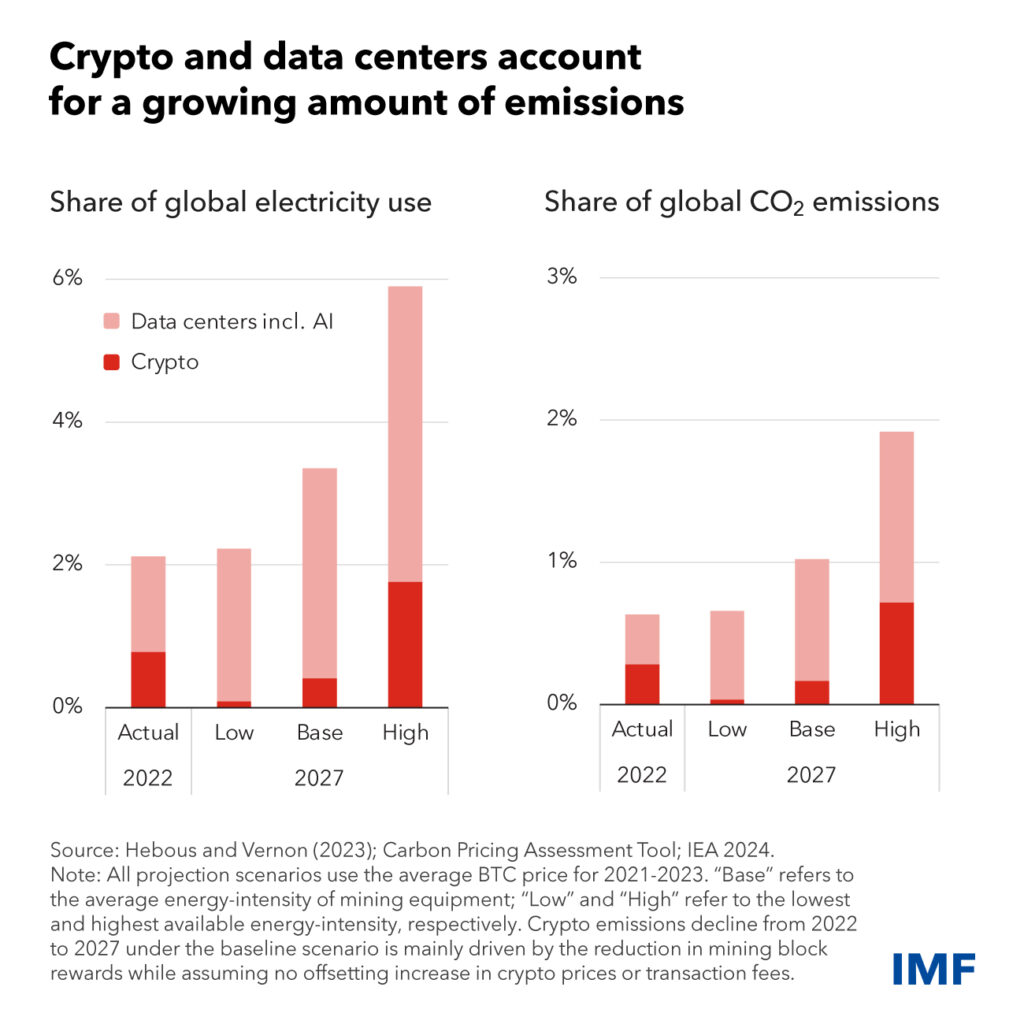
The International Monetary Fund (IMF) has raised concerns over the rising carbon emissions from crypto mining and AI data centers, which now account for 2% of global electricity use and nearly 1% of worldwide emissions. To address this growing environmental challenge, the IMF has proposed a targeted increase in electricity taxes for these industries.
According to the IMF, crypto mining and AI data centers are projected to consume 3.5% of global electricity within the next three years—equivalent to the current electricity consumption of Japan, the world’s fifth-largest electricity user. This surge in energy use is expected to contribute significantly to global carbon emissions, with crypto mining alone potentially generating 0.7% of global carbon dioxide emissions by 2027.
The IMF suggests a direct tax of $0.047 per kilowatt hour on electricity used by crypto miners. This tax could increase to $0.089 per kilowatt hour when accounting for air pollution's broader health impacts, representing an 85% hike in electricity costs for miners. The IMF estimates that such a tax could reduce annual emissions by 100 million tons—comparable to Belgium’s current emissions—and generate $5.2 billion in revenue for governments globally.
For AI data centers, the IMF proposes a slightly lower targeted tax of $0.032 per kilowatt hour, or $0.052 when including air pollution costs. This measure could potentially raise up to $18 billion annually.
The IMF acknowledges that many crypto miners and data centers currently benefit from tax exemptions and incentives. However, given the environmental damage, limited employment benefits, and strain on electrical grids, the IMF questions the net benefits of these favorable tax regimes.
To mitigate the environmental impact, the IMF recommends complementing electricity taxes with incentives for zero-emission power sources, bilateral power purchase agreements, and renewable energy certificates. Additionally, the IMF emphasizes the importance of cross-border coordination to prevent crypto miners and data centers from relocating to jurisdictions with lower environmental standards.
Iran is intensifying its crackdown on illegal cryptocurrency mining as the country faces a severe power crisis worsened by an intense heatwave. Unauthorized mining is straining Iran’s power grid, causing widespread industrial disruptions, according to authorities.
To address the issue, Iranian officials have launched a bounty program, offering one million toman (about $20) to those who report unauthorized mining operations. So far, over 230,000 illegal mining devices—using as much electricity as the entire Markazi Province—have been seized.
The crackdown highlights growing concerns over the impact of illegal crypto mining on Iran’s infrastructure, with reports suggesting foreign entities, including Chinese companies, may be involved.

Disclaimer of Warranty
The information provided in this article is for general informational purposes only. We make no warranties about the completeness, reliability, and accuracy of this information. Read full disclaimer

Editor's Picks
In the Same Space

IMF Warns AI Could Hit 40% of Jobs, With Young Workers in the Firing Line

News Desk

Oct 13, 2026

5 min

Bitcoin ETFs Reverse Outflows With $1B in Three-Day Inflows
News Desk
Oct 22, 2026
7 min

Robinhood Plans Dubai Launch in 2027 After DFSA Authorization
Walid Abou Zaki
Oct 22, 2026
4 min

Qafila 2026: Binance Looks Beyond the First Crypto Trade
Salma Naueihed
Oct 22, 2026
6 min