Advertisement
Regulation & Policy
Share
WA
CEO & Editor-in-Chief


In a significant joint enforcement action, the Financial Services Regulatory Authority (FSRA) and the Registration Authority (RA) of Abu Dhabi Global Market (ADGM) concluded parallel investigations into AC Holding Limited (HAYVN) and its former CEO Christopher Flinos, imposing cumulative financial penalties totaling $12.46 million and issuing permanent regulatory sanctions.
According to the FSRA, Flinos engaged in fraudulent trading, falsified company documents to maintain banking relationships, and exceeded the scope of HAYVN’s ADGM license by offering unlicensed cryptocurrency-to-fiat conversion services.
Unlock Blockchain has followed the HAYVN story since early 2024, when signs of board-level turmoil, a sudden CEO resignation, and technical disruptions first emerged. (Read our earlier coverage here)
The investigations by ADGM's FSRA and RA found that between October 2018 and May 2024, AC Holding Limited (HAYVN) engaged in serious and sustained misconduct. This included:
The misconduct involved misleading multiple counterparties, including clients and banking partners, and revealed widespread internal failures in compliance, governance, and transparency. Flinos is accused of centrally directing and concealing these actions across the Hayvn group of companies.
In announcing the enforcement, Hamad Sayah Al Mazrouei, CEO of ADGM Registration Authority, stated: "Maintaining business integrity and safeguarding business confidence in ADGM are at the forefront of the Registration Authority’s objectives. We remain committed to preventing and deterring conduct that may harm businesses, their clients and investors. Where non-compliance is identified, the Registration Authority will take effective, proportionate and dissuasive disciplinary action."
The FSRA echoed this, "This case illustrates the importance of proper licensing and full disclosure to the FSRA. We take this conduct seriously and will continue to pursue enforcement actions against those who undermine the integrity of ADGM’s financial system," said Emmanuel Givanakis, CEO of the FSRA.
In a coordinated action, both the Financial Services Regulatory Authority (FSRA) and the Registration Authority (RA) of ADGM issued enforcement decisions following a comprehensive investigation into the operations of the HAYVN group and its founder Christopher Flinos. This joint action reflects the seriousness of the misconduct and the integrated oversight framework within ADGM.
The enforcement resulted in total financial penalties of $12.46 million, imposed separately by the FSRA and RA across multiple parties:
In addition:
According to regulators, Flinos played a central role in directing unlicensed activities and providing false and misleading information. Over 200 falsified documents were submitted under his direction to support unregulated transactions through the SPV.
One of the most significant revelations in FSRA’s findings is that Flinos used falsified company documents to maintain bank accounts. While the full extent of the banking relationships is unclear, sources confirm that Australian banks were involved and not UAE banks.
The extent of potential regulatory scrutiny in Australia remains uncertain. If Australian banks unknowingly facilitated fraudulent transactions, this could trigger further investigations by AUSTRAC (Australia’s financial intelligence unit) or APRA (Australian Prudential Regulation Authority).
Deus X Pay has positioned itself as a regulated digital payments company, operating under Virtual Asset Service Provider (VASP) licenses in Lithuania and the Czech Republic. In Lithuania, it operates as Zeply Global UAB, under the supervision of the Financial Crime Investigation Service (FNTT). In the Czech Republic, it operates as TitanToken Tech s.r.o., supervised by the Financial Analytical Office (FAU). Additionally, Deus X Pay is pursuing a license from Dubai’s Virtual Assets Regulatory Authority (VARA), marking a significant step toward establishing its operations in the UAE and reinforcing its commitment to regional expansion.
The company has clarified that while Deus X Capital acquired certain assets from HAYVN, it did not acquire the company itself. Deus X Pay operates independently with its own regulatory licenses and compliance measures, ensuring a structured and compliant framework.
Earlier in its communications, Deus X Pay positioned itself as a rebranding of HAYVN, leading many to assume a direct continuation of the former business. However, in light of recent developments, the narrative has shifted. Deus X Pay now emphasizes its distinct legal and operational identity, seeking to draw a clearer line between its platform and the collapsed HAYVN structure.
As part of its growth, Deus X Pay has welcomed former HAYVN clients and employees, emphasizing its focus on continuity and compliance while building a reputation distinct from past controversies. With a clear operational strategy and regulatory commitment, Deus X Pay is positioning itself as a trusted player in the global digital payments industry.
While the regulatory penalties issued by ADGM’s FSRA and RA are civil in nature, the severity and scope of the misconduct — including over 200 falsified documents and misrepresentation to financial institutions — raises the question of whether criminal proceedings could follow. Given that Flinos is currently believed to be residing in Australia, and that an extradition treaty exists between the UAE and Australia, a formal case could potentially cross jurisdictions if authorities decide to pursue further legal action. For now, the matter remains one of regulatory enforcement, but its scale and implications suggest this may not be the final chapter.
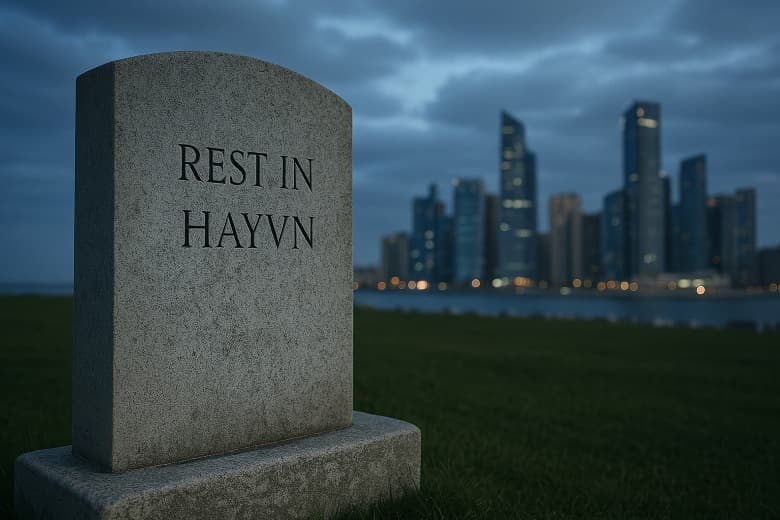
With the FSRA’s decision, HAYVN ceases to exist—not as a result of regulatory enforcement alone, but due to failed leadership and mismanagement. Once seen as a promising player in the digital asset space, its downfall reflects the consequences of corporate misconduct.
At the same time, the case also stands as a testament to the robustness and maturity of ADGM’s regulatory ecosystem. The coordinated action between the FSRA and the RA underscores ADGM’s ability to detect, investigate, and act decisively against wrongdoing — even when it involves a high-profile market player. As global digital asset markets evolve, ADGM continues to demonstrate its commitment to transparency, accountability, and investor protection.
While the industry moves forward, HAYVN’s legacy will remain a cautionary tale of how ambition, when unchecked by compliance, can lead to collapse.

Disclaimer of Warranty
The information provided in this article is for general informational purposes only. We make no warranties about the completeness, reliability, and accuracy of this information. Read full disclaimer

Editor's Picks
In the Same Space

Robinhood Plans Dubai Launch in 2027 After DFSA Authorization

Walid Abou Zaki

Oct 22, 2026

4 min

VARA Grants Bybit License for Spot Trading in Dubai
Walid Abou Zaki
Oct 22, 2026
6 min
OCC Finalizes GENIUS Act Rules for Stablecoin Issuers
News Desk
Oct 21, 2026
3 min

Coinbase Among Six Platforms Facing Kazakhstan AIFC Restrictions
News Desk
Oct 21, 2026
3 min