Advertisement
Exchanges & Trading
Share
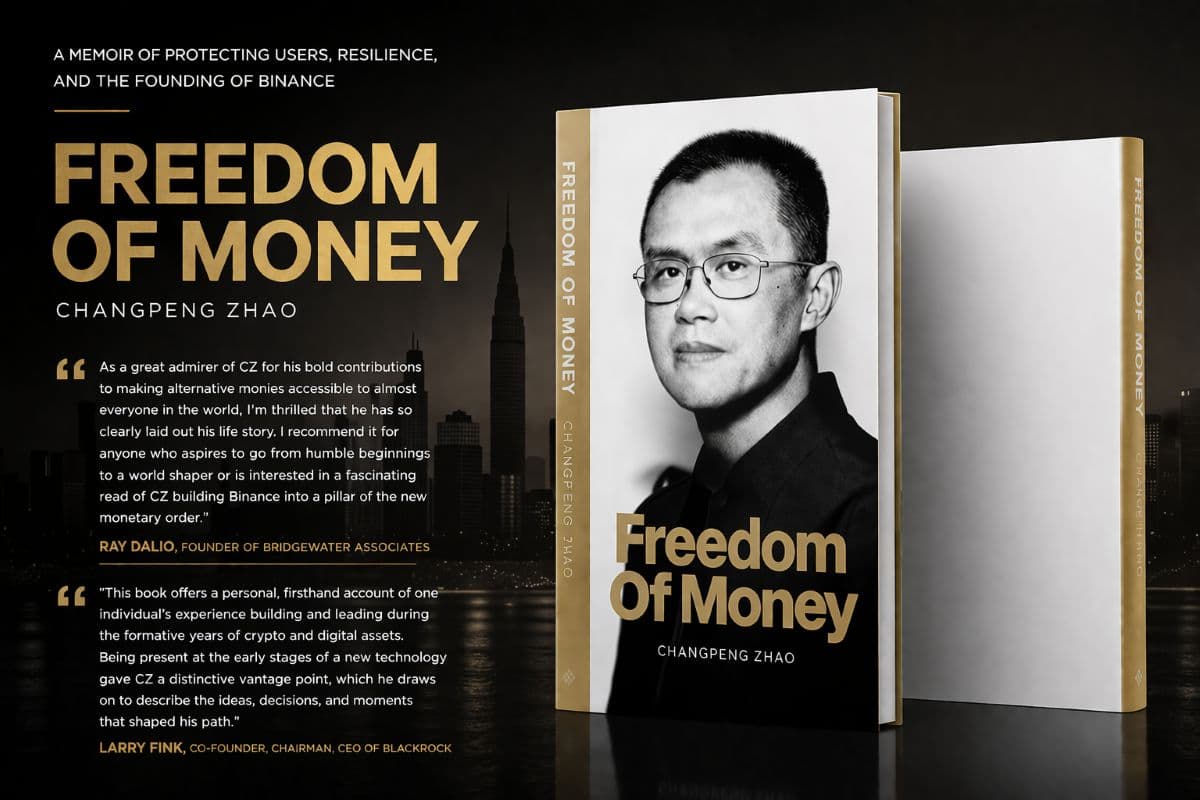
Changpeng Zhao has published a memoir that offers one of the most direct accounts yet of what it was like to build a major crypto platform during the industry's most explosive growth period. Freedom of Money: A Memoir of Protecting Users, Resilience, and the Founding of Binance, released globally on April 8, chronicles CZ's path from early life through Binance's rapid expansion and his recent four-month federal prison sentence.
The book arrives at a moment when the crypto industry's foundational period is being reassessed through the lens of regulatory enforcement and market maturation. CZ's account provides a builder's perspective on decisions that shaped not just Binance, but how exchanges approached compliance, user protection, and global expansion during a time when regulatory frameworks were still forming.
The memoir traces how Binance grew from a 2017 startup to a platform serving 300 million users with a $100 billion valuation by 2026. But the more significant story CZ tells is about the operational philosophy that drove that growth. "While many people congratulated me on being number one, something else gave me more satisfaction," he writes. "I was getting messages from users all around the world thanking us for providing them with financial access or even financial freedom."
That focus on financial access, particularly in developing markets where traditional banking infrastructure remained limited, became central to how Binance positioned itself. The memoir details how this mission-driven approach influenced product development and market entry decisions, even as regulatory scrutiny intensified.
CZ addresses his legal battles directly, including the Department of Justice case that resulted in his prison sentence. He was charged with a single violation of the Bank Secrecy Act related to Binance's early compliance programs and allowing U.S. users on the platform. The case resulted in a $4.3 billion fine for Binance and a $150 million personal fine for CZ.
What makes CZ's account notable is his framing of the enforcement action. He emphasizes that no fraud or money laundering charges were brought, and that Binance was not physically operating in the United States during the period in question. His lawyers had assured him that criminal prosecution was unlikely for this type of violation, and that prison time was not expected.
The memoir also details CZ's experience with U.S. immigration enforcement following his release, when he was detained by the Department of Homeland Security for allegedly overstaying his visa — despite being required to remain in the U.S. during his legal proceedings.

Judge Approves Binance’s $4.3 Billion Payment in US Plea Deal
2 minFor institutional readers in markets like Dubai, CZ's regulatory experience offers insights into how different jurisdictions approach crypto compliance. His account highlights the tension between national regulatory approaches and the global nature of digital asset platforms.
The memoir provides a case study in how quickly regulatory expectations can shift for companies operating across multiple jurisdictions. CZ's experience with U.S. enforcement, despite Binance not being physically based in the U.S., illustrates the extraterritorial reach that American regulators have claimed over global crypto platforms.
The book also addresses major industry events, including the FTX collapse and the broader impact on crypto market confidence. CZ's perspective on how Binance navigated that period — and maintained user trust while competitors faced liquidity crises — provides insight into operational resilience during market stress.
Richard Teng, Binance Co-CEO, noted that "the story of Binance is closely tied to the early evolution of the crypto industry." The memoir captures how platform leadership during crypto's formative years required balancing rapid innovation with emerging compliance requirements.
What distinguishes Freedom of Money from other crypto industry accounts is its focus on operational decision-making rather than just market dynamics. CZ details how Binance approached talent acquisition, product development, and user protection while scaling globally.
The memoir offers a founder's view of building infrastructure for an industry where the rules were still being written. For Dubai's digital asset ecosystem, where regulatory clarity has been a competitive advantage, CZ's account provides a contrast in how different approaches to compliance and market entry can shape platform development.
Freedom of Money is available on Amazon Kindle and in paperback. For institutional readers tracking how the crypto industry's foundational period is being documented and reassessed, CZ's account provides one of the most direct perspectives yet on what it was like to build at the center of that expansion.

Disclaimer of Warranty
The information provided in this article is for general informational purposes only. We make no warranties about the completeness, reliability, and accuracy of this information. Read full disclaimer

Editor's Picks

When Assets Move—or Stop—Without Consent: The Limits of Crypto Wallet Control

Walid Abou Zaki

Sep 29, 2026

6 min

Where Do the Dollars Behind the UAE’s Crypto Economy Sit?
Anna K.
Sep 21, 2026
9 min

As U.S. Crypto Legislation Stalls, Circle Launches Its Own Financial Network
Walid Abou Zaki
Sep 16, 2026
9 min
Read More Articles

In the Same Space

Binance Invests $100M in Circle, Extends USDC Partnership for Five Years
News Desk
Sep 22, 2026
2 min

MiCA Stablecoin Rules Face a Reality Check as Circle Calls for Change
Walid Abou Zaki
Oct 5, 2026
11 min

Hong Kong Prepares to Rewrite the Rules for Virtual Assets, Licensing Bill Planned for 2026
News Desk
Oct 5, 2026
4 min

S&P Global Takes On DeFi’s $10B Lending Boom With New Risk Framework
News Desk
Oct 5, 2026
4 min